for the function f given by f(x)=3 + 2e^(-x), for which of the following values of x is f(x)=11? x=-ln 4…
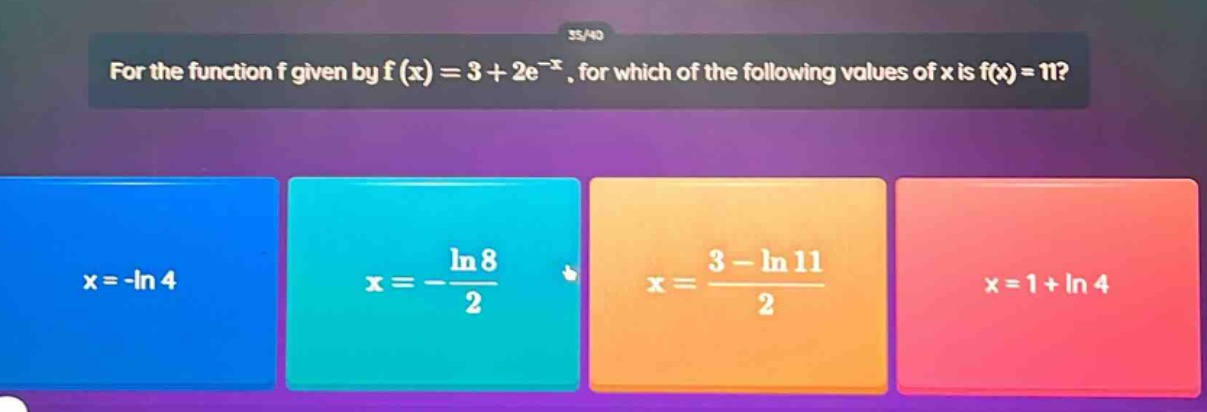
for the function f given by f(x)=3 + 2e^(-x), for which of the following values of x is f(x)=11? x=-ln 4 x=-ln 8/2 x=(3 - ln 11)/2 x=1+ln 4
Answer
Explanation:
Step1: Set up the equation
Set (f(x)=11) in the function (f(x)=3 + 2e^{-x}), so we get (11=3 + 2e^{-x}).
Step2: Isolate the exponential - term
Subtract 3 from both sides of the equation: (11 - 3=2e^{-x}), which simplifies to (8 = 2e^{-x}). Then divide both sides by 2, we have (4=e^{-x}).
Step3: Take the natural logarithm of both sides
Taking the natural - logarithm of both sides, (\ln(4)=\ln(e^{-x})).
Step4: Use the property of logarithms
Since (\ln(e^{a})=a), then (\ln(4)=-x). So (x =-\ln(4)).
Answer:
(x =-\ln 4)