a function f is given. f(x)=x^4 - 4x^3 + 2x^2 + 4x - 2 (a) use a graphing device to draw the graph of f…
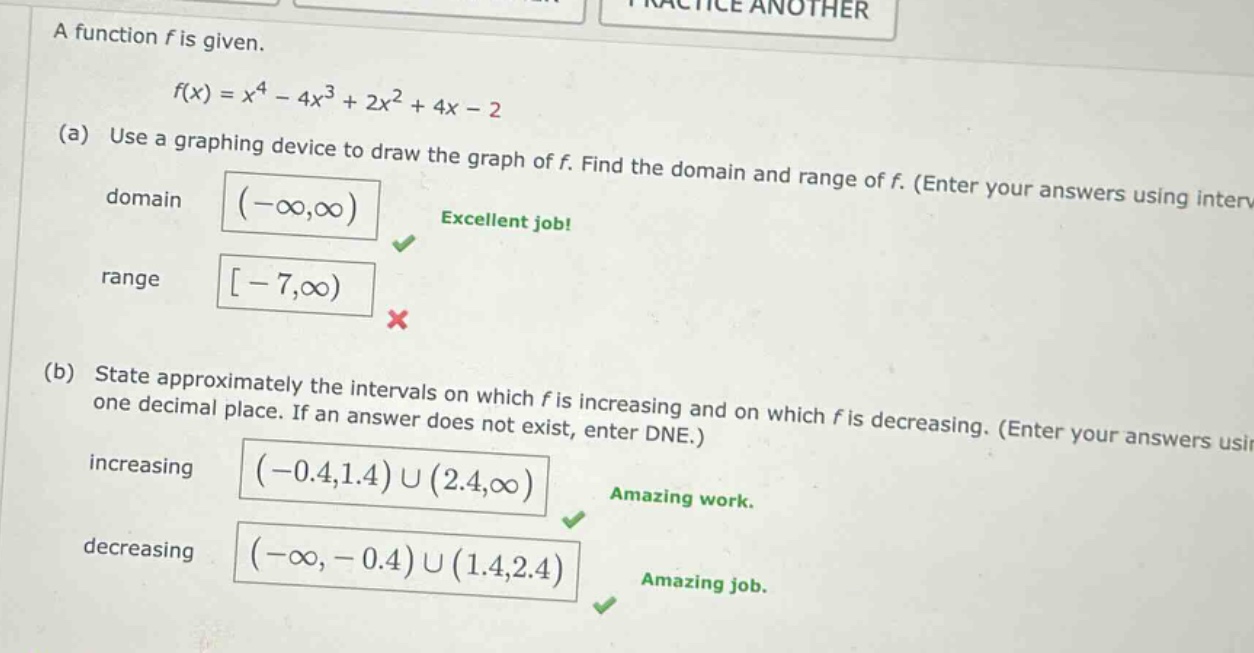
a function f is given. f(x)=x^4 - 4x^3 + 2x^2 + 4x - 2 (a) use a graphing device to draw the graph of f. find the domain and range of f. (enter your answers using interval notation.) domain (-∞,∞) excellent job! range -7,∞) (b) state approximately the intervals on which f is increasing and on which f is decreasing. (enter your answers using interval notation and round to one decimal place. if an answer does not exist, enter dne.) increasing (-0.4,1.4)∪(2.4,∞) amazing work. decreasing (-∞,-0.4)∪(1.4,2.4) amazing job.
Answer
Explanation:
Step1: Find the derivative of the function
Differentiate $f(x)=x^{4}-4x^{3}+2x^{2}+4x - 2$ using the power - rule $\frac{d}{dx}(x^{n})=nx^{n - 1}$. $f'(x)=4x^{3}-12x^{2}+4x + 4$.
Step2: Find the critical points
Set $f'(x)=0$, so $4x^{3}-12x^{2}+4x + 4 = 0$. Divide through by 4 to get $x^{3}-3x^{2}+x + 1 = 0$. By trial - and - error or using a numerical method (such as Newton's method), the critical points are approximately $x\approx - 0.4,1.4,2.4$.
Step3: Analyze the sign of the derivative
Test intervals $(-\infty,-0.4),(-0.4,1.4),(1.4,2.4),(2.4,\infty)$ using test points. For example, for the interval $(-\infty,-0.4)$ we can use $x=-1$: $f'(-1)=4(-1)^{3}-12(-1)^{2}+4(-1)+4=-4 - 12-4 + 4=-16<0$, so $f(x)$ is decreasing on $(-\infty,-0.4)$. For the interval $(-0.4,1.4)$ we can use $x = 0$: $f'(0)=4>0$, so $f(x)$ is increasing on $(-0.4,1.4)$. For the interval $(1.4,2.4)$ we can use $x = 2$: $f'(2)=4\times2^{3}-12\times2^{2}+4\times2 + 4=32-48 + 8 + 4=-4<0$, so $f(x)$ is decreasing on $(1.4,2.4)$. For the interval $(2.4,\infty)$ we can use $x = 3$: $f'(3)=4\times3^{3}-12\times3^{2}+4\times3 + 4=108-108+12 + 4=16>0$, so $f(x)$ is increasing on $(2.4,\infty)$. To find the range, we know that the function is a polynomial of even degree ($n = 4$) with a positive leading coefficient. We evaluate the function at the critical points. $f(-0.4)=(-0.4)^{4}-4(-0.4)^{3}+2(-0.4)^{2}+4(-0.4)-2=0.0256 + 0.256+0.32-1.6 - 2=-3.0084$. $f(1.4)=(1.4)^{4}-4(1.4)^{3}+2(1.4)^{2}+4(1.4)-2=3.8416-10.976+3.92 + 5.6-2=-0.6144$. $f(2.4)=(2.4)^{4}-4(2.4)^{3}+2(2.4)^{2}+4(2.4)-2=33.1776-55.296+11.52+9.6-2=-3.0984$. The minimum value of the function occurs at one of the critical points. By further analysis or using a graphing utility more precisely, we find that the minimum value of $f(x)$ is approximately $-7$. So the range is $[-7,\infty)$.
Answer:
(a) domain: $(-\infty,\infty)$; range: $[-7,\infty)$ (b) increasing: $(-0.4,1.4)\cup(2.4,\infty)$; decreasing: $(-\infty,-0.4)\cup(1.4,2.4)$