the function $f$ is given by $f(x)=4x^{3}-x^{4}$. on what intervals is the graph of $f$ concave up?\n(a)…
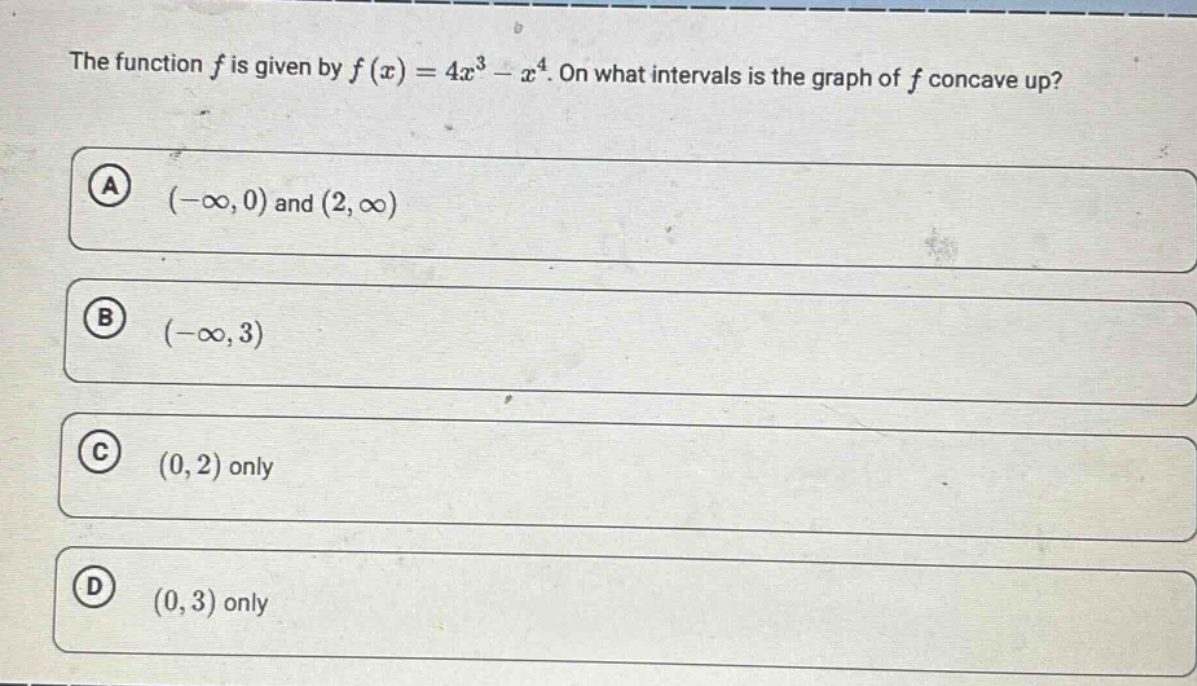
the function $f$ is given by $f(x)=4x^{3}-x^{4}$. on what intervals is the graph of $f$ concave up?\n(a) $(-\\infty,0)$ and $(2,\\infty)$\n(b) $(-\\infty,3)$\n(c) $(0,2)$ only\n(d) $(0,3)$ only
Answer
Explanation:
Step1: Find the first - derivative
Using the power rule $(x^n)'=nx^{n - 1}$, for $f(x)=4x^{3}-x^{4}$, we have $f'(x)=12x^{2}-4x^{3}$.
Step2: Find the second - derivative
Differentiate $f'(x)$ again. $f''(x)=24x - 12x^{2}=12x(2 - x)$.
Step3: Determine where $f''(x)>0$
Set $f''(x)>0$, so $12x(2 - x)>0$. The roots of the equation $12x(2 - x)=0$ are $x = 0$ and $x = 2$. We can use a sign - chart or test intervals. If we consider the intervals $(-\infty,0)$, $(0,2)$ and $(2,\infty)$. For $x\in(-\infty,0)$, let $x=-1$, then $f''(-1)=12\times(-1)\times(2+1)=-36<0$. For $x\in(0,2)$, let $x = 1$, then $f''(1)=12\times1\times(2 - 1)=12>0$. For $x\in(2,\infty)$, let $x = 3$, then $f''(3)=12\times3\times(2 - 3)=-36<0$. So the function $f(x)$ is concave up on the interval $(0,2)$.
Answer:
C. $(0,2)$ only