the function g is given by g(x) = (7x - 26)/(x - 5). the function h is given by h(x) = (3x + 11)/(2x + 1)…
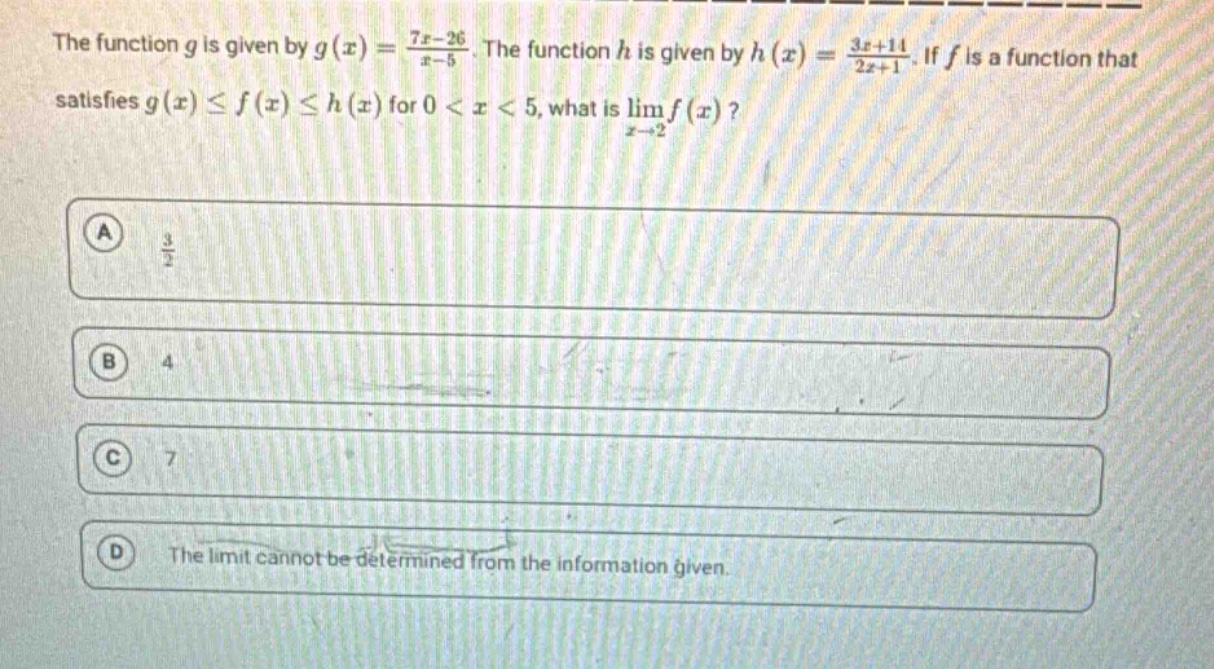
the function g is given by g(x) = (7x - 26)/(x - 5). the function h is given by h(x) = (3x + 11)/(2x + 1). if f is a function that satisfies g(x) ≤ f(x) ≤ h(x) for 0 < x < 5, what is lim f(x) as x→2? a 3/2 b 4 c 7 d the limit cannot be determined from the information given.
Answer
Explanation:
Step1: Find $\lim_{x\rightarrow2}g(x)$
Use direct - substitution for $g(x)=\frac{7x - 26}{x - 5}$. Substitute $x = 2$ into $g(x)$: [ \begin{align*} \lim_{x\rightarrow2}g(x)&=\frac{7\times2-26}{2 - 5}\ &=\frac{14 - 26}{-3}\ &=\frac{-12}{-3}\ & = 4 \end{align*} ]
Step2: Find $\lim_{x\rightarrow2}h(x)$
Use direct - substitution for $h(x)=\frac{3x + 11}{2x+1}$. Substitute $x = 2$ into $h(x)$: [ \begin{align*} \lim_{x\rightarrow2}h(x)&=\frac{3\times2 + 11}{2\times2+1}\ &=\frac{6 + 11}{4 + 1}\ &=\frac{17}{5}= 4 \end{align*} ]
Step3: Apply the Squeeze Theorem
Since $g(x)\leq f(x)\leq h(x)$ for $0\lt x\lt5$ and $\lim_{x\rightarrow2}g(x)=\lim_{x\rightarrow2}h(x)=4$, by the Squeeze Theorem, $\lim_{x\rightarrow2}f(x)=4$.
Answer:
B. 4