the function g is given by g(x)=3 csc(π(x + 2)) - 1. which of the following describes the range of g? a the…
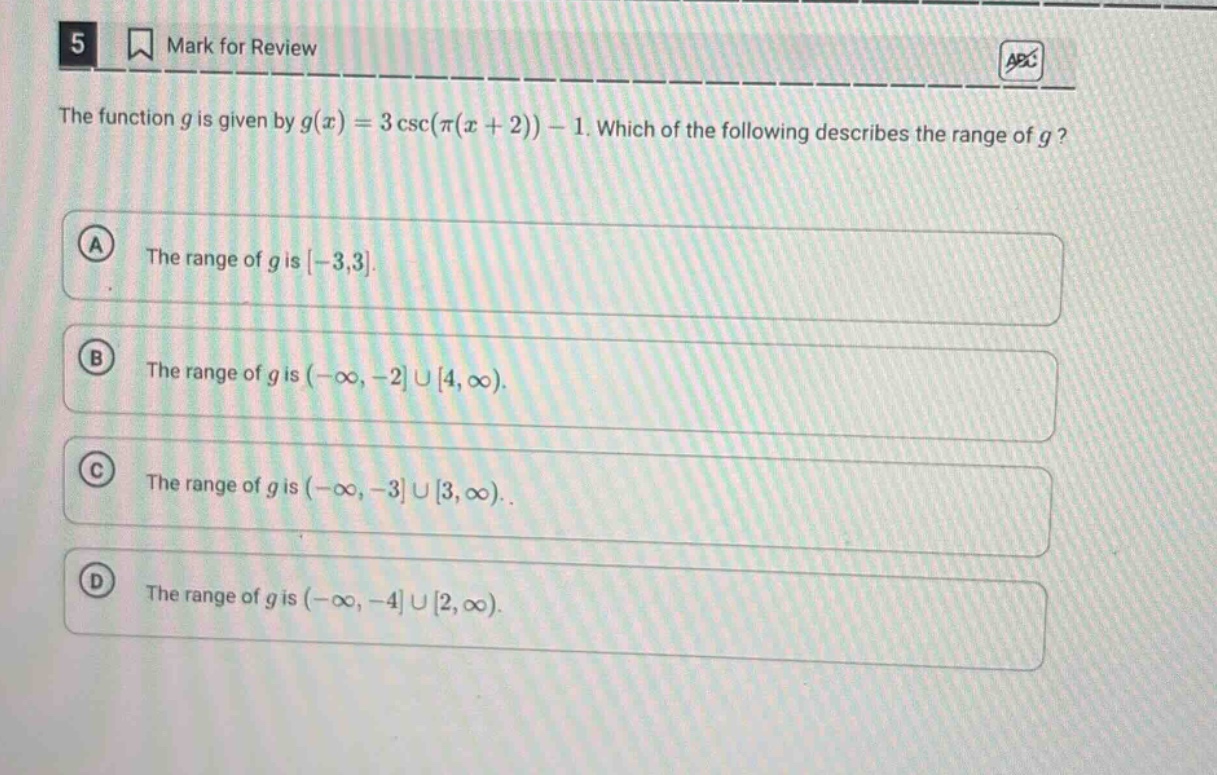
the function g is given by g(x)=3 csc(π(x + 2)) - 1. which of the following describes the range of g? a the range of g is -3,3. b the range of g is (-∞,-2 ∪ 4,∞). c the range of g is (-∞,-3 ∪ 3,∞). d the range of g is (-∞,-4 ∪ 2,∞).
Answer
Explanation:
Step1: Recall range of cosecant function
The range of the basic cosecant function $y = \csc(t)$ is $(-\infty,- 1]\cup[1,\infty)$.
Step2: Consider the transformation of the given function
Let $t=\pi(x + 2)$. Then $y = 3\csc(t)-1$. When $\csc(t)=1$, $y=3\times1 - 1=2$. When $\csc(t)=-1$, $y=3\times(-1)-1=-4$. Since the range of $\csc(t)$ is $(-\infty,-1]\cup[1,\infty)$, when we multiply by 3 and subtract 1: If $\csc(t)\leq - 1$, then $y = 3\csc(t)-1\leq3\times(-1)-1=-4$. If $\csc(t)\geq1$, then $y = 3\csc(t)-1\geq3\times1 - 1=2$. So the range of $g(x)$ is $(-\infty,-4]\cup[2,\infty)$.
Answer:
D. The range of $g$ is $(-\infty,-4]\cup[2,\infty)$.