the function m is given by m(x) = log10e + log10(x^(-1)). which of the following statements about m is true…
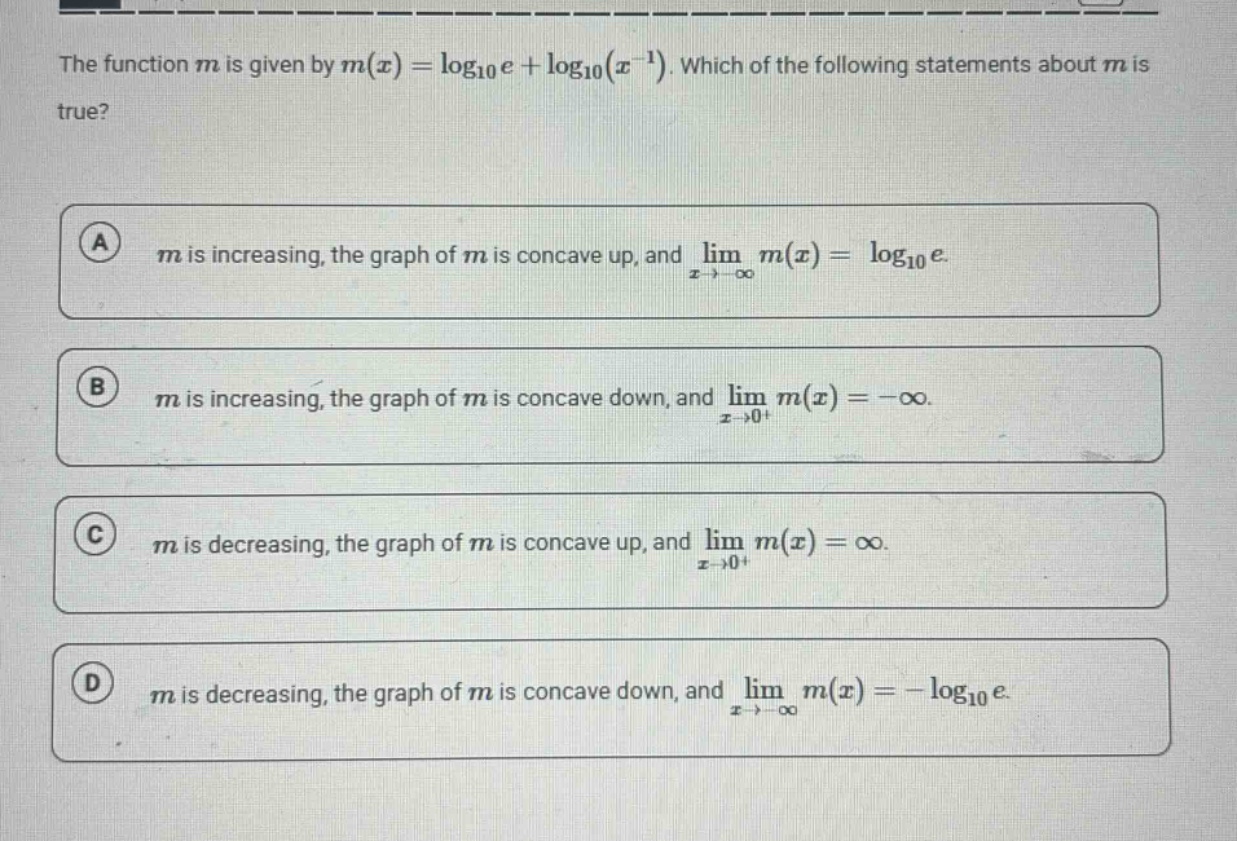
the function m is given by m(x) = log10e + log10(x^(-1)). which of the following statements about m is true? a m is increasing, the graph of m is concave up, and lim(x→ -∞) m(x) = log10e. b m is increasing, the graph of m is concave down, and lim(x→0+) m(x) = -∞. c m is decreasing, the graph of m is concave up, and lim(x→0+) m(x) = ∞. d m is decreasing, the graph of m is concave down, and lim(x→ -∞) m(x) = -log10e.
Answer
Explanation:
Step1: Simplify the function
Using the logarithm property $\log_a b+\log_a c=\log_a(bc)$, we have $m(x)=\log_{10}(e\cdot x^{-1})=\log_{10}(\frac{e}{x})=\log_{10}e-\log_{10}x$.
Step2: Find the first - derivative
The derivative of $\log_{10}x$ is $\frac{1}{x\ln 10}$. So, $m^\prime(x)=0 - \frac{1}{x\ln 10}=-\frac{1}{x\ln 10}$. For $x>0$, $m^\prime(x)<0$, so the function $m(x)$ is decreasing.
Step3: Find the second - derivative
The derivative of $m^\prime(x)=-\frac{1}{x\ln 10}=-\frac{1}{\ln 10}x^{-1}$. Using the power - rule for differentiation $(x^n)^\prime = nx^{n - 1}$, we get $m^{\prime\prime}(x)=\frac{1}{x^{2}\ln 10}>0$ for $x > 0$. So the graph of $m(x)$ is concave up.
Step4: Find the limit as $x\rightarrow0^{+}$
$\lim_{x\rightarrow0^{+}}m(x)=\lim_{x\rightarrow0^{+}}(\log_{10}e-\log_{10}x)=\infty$ since $\lim_{x\rightarrow0^{+}}\log_{10}x=-\infty$.
Answer:
C. $m$ is decreasing, the graph of $m$ is concave up, and $\lim_{x\rightarrow0^{+}}m(x)=\infty$