the function f is given by f(x) = sin x. it is claimed that if f(x) = b/a, where a ≠ 0 and |b/a| ≤ 1, then…
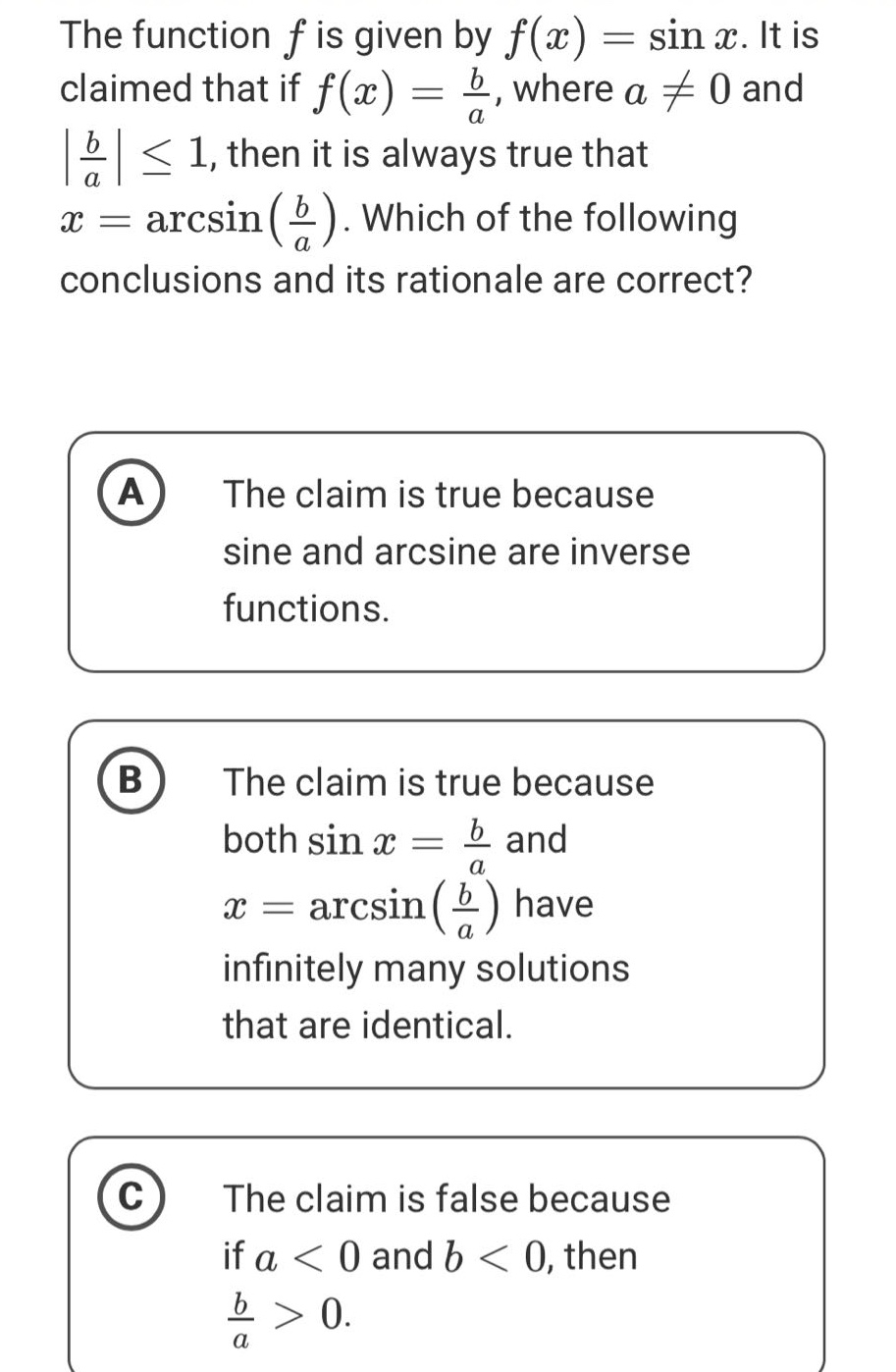
the function f is given by f(x) = sin x. it is claimed that if f(x) = b/a, where a ≠ 0 and |b/a| ≤ 1, then it is always true that x = arcsin(b/a). which of the following conclusions and its rationale are correct? a the claim is true because sine and arcsine are inverse functions. b the claim is true because both sin x = b/a and x = arcsin(b/a) have infinitely many solutions that are identical. c the claim is false because if a < 0 and b < 0, then b/a > 0.
Answer
Explanation:
Step1: Recall the domain and range of arcsine
The function $y = \arcsin(t)$ has a domain $- 1\leq t\leq1$ and range $-\frac{\pi}{2}\leq y\leq\frac{\pi}{2}$. The equation $\sin x=\frac{b}{a}$ ($|\frac{b}{a}|\leq1$) has infinitely - many solutions for $x\in R$, while $x = \arcsin(\frac{b}{a})$ gives only one solution in the range $[-\frac{\pi}{2},\frac{\pi}{2}]$.
Step2: Analyze option A
Although sine and arcsine are inverse - like functions, the arcsine function is the inverse of the restricted sine function $y = \sin x,x\in[-\frac{\pi}{2},\frac{\pi}{2}]$. Just saying they are inverse functions is not enough to conclude that if $\sin x=\frac{b}{a}$, then $x=\arcsin(\frac{b}{a})$ for all $x$. So option A is incorrect.
Step3: Analyze option B
The equation $\sin x=\frac{b}{a}$ has solutions $x = \arcsin(\frac{b}{a})+2k\pi$ or $x=\pi-\arcsin(\frac{b}{a}) + 2k\pi,k\in Z$, while $x=\arcsin(\frac{b}{a})$ is just one particular solution in the range $[-\frac{\pi}{2},\frac{\pi}{2}]$. They do not have identical infinitely - many solutions. So option B is incorrect.
Step4: Analyze option C
The fact that if $a\lt0$ and $b\lt0$, then $\frac{b}{a}\gt0$ is not relevant to the incorrectness of the claim. The main reason the claim is false is due to the range restriction of the arcsine function.
The claim is false because the arcsine function $\arcsin$ gives a single value in the interval $[-\frac{\pi}{2},\frac{\pi}{2}]$, while the equation $\sin x=\frac{b}{a}$ has infinitely many solutions for $x\in R$. None of the given options are correct.
Answer:
None of the options A, B, C are correct.