the function g is given by g(x) = a tan(x) + d, where a and d are constants. which of the following…
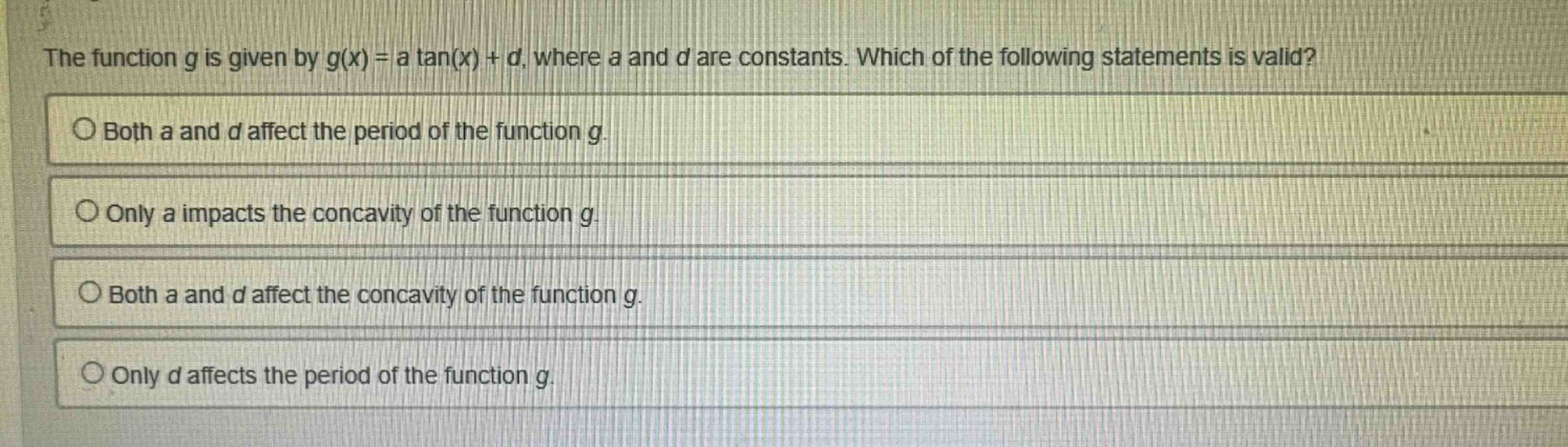
the function g is given by g(x) = a tan(x) + d, where a and d are constants. which of the following statements is valid?\nboth a and d affect the period of the function g.\nonly a impacts the concavity of the function g.\nboth a and d affect the concavity of the function g.\nonly d affects the period of the function g.
Answer
Explanation:
Step1: Recall period - property of tangent function
The period of the basic tangent function (y = \tan(x)) is (\pi). For the function (y=a\tan(x)+d), the period is still (\pi) and is not affected by (a) and (d). So, options related to period - affecting by (a) and (d) are incorrect.
Step2: Recall concavity - property of tangent function
The concavity of a function is related to its second - derivative. The second - derivative of (y = \tan(x)) is (y''=2\sec^{2}(x)\tan(x)). For the function (g(x)=a\tan(x)+d), its first - derivative (g'(x)=a\sec^{2}(x)) and second - derivative (g''(x)=2a\sec^{2}(x)\tan(x)). The constant (d) does not affect the second - derivative. Only the coefficient (a) affects the sign and magnitude of the second - derivative, and thus only (a) impacts the concavity of the function (g).
Answer:
Only a impacts the concavity of the function g.