the function $g$ is given by $g(\theta)=cos\theta$. which of the following describes $g$ on the interval…
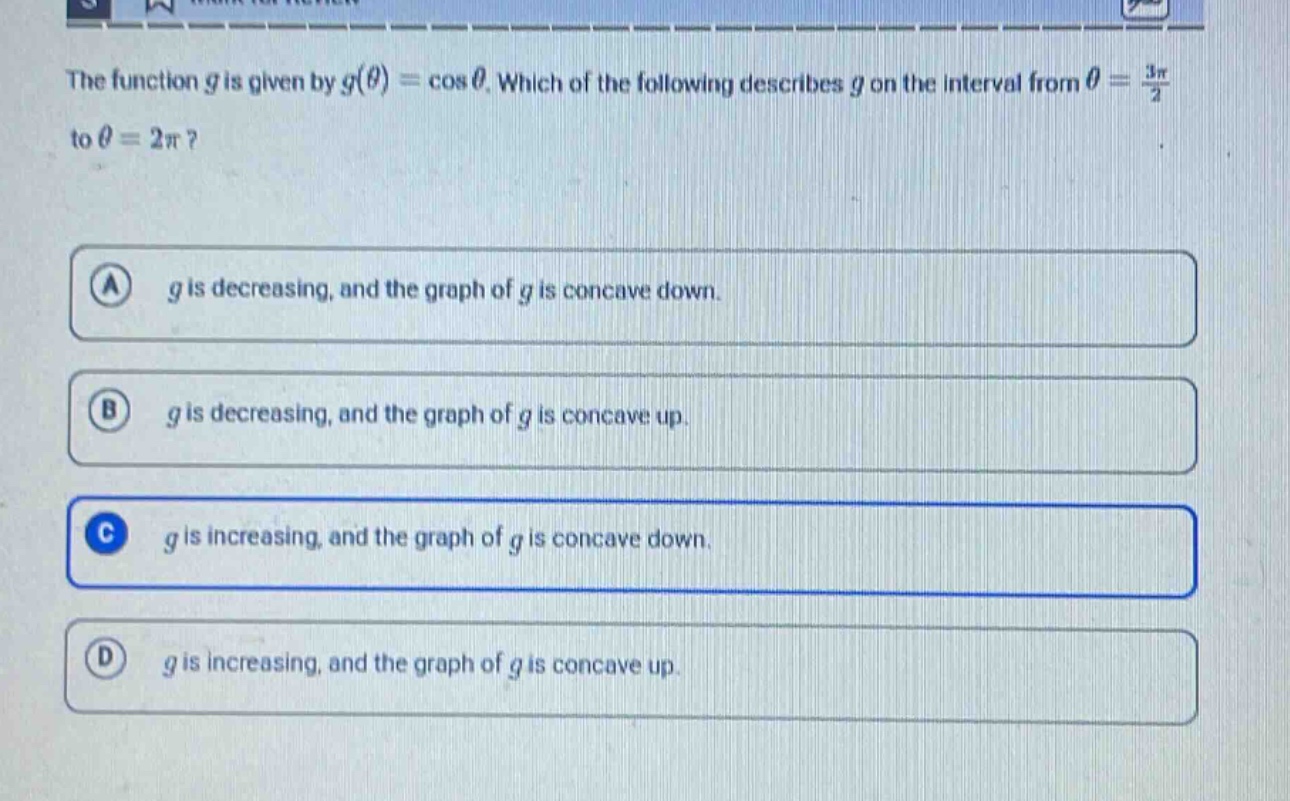
the function $g$ is given by $g(\theta)=cos\theta$. which of the following describes $g$ on the interval from $\theta = \frac{3pi}{2}$ to $\theta = 2pi$?\na $g$ is decreasing, and the graph of $g$ is concave down.\nb $g$ is decreasing, and the graph of $g$ is concave up.\nc $g$ is increasing, and the graph of $g$ is concave down.\nd $g$ is increasing, and the graph of $g$ is concave up.
Answer
Explanation:
Step1: Find the first - derivative
The derivative of $g(\theta)=\cos\theta$ is $g'(\theta)=-\sin\theta$. On the interval $\theta\in[\frac{3\pi}{2},2\pi]$, $\sin\theta$ is negative, so $g'(\theta)=-\sin\theta> 0$. When $g'(\theta)>0$, the function $g(\theta)$ is increasing.
Step2: Find the second - derivative
The second - derivative of $g(\theta)$ is $g''(\theta)=-\cos\theta$. On the interval $\theta\in[\frac{3\pi}{2},2\pi]$, $\cos\theta$ is positive, so $g''(\theta)=-\cos\theta<0$. When $g''(\theta)<0$, the graph of the function $g(\theta)$ is concave down.
Answer:
C. $g$ is increasing, and the graph of $g$ is concave down.