a function $f(x)$ has a given value $f(0)= - 1$. a graph of the derivative $f(x)$ is given below. what is…
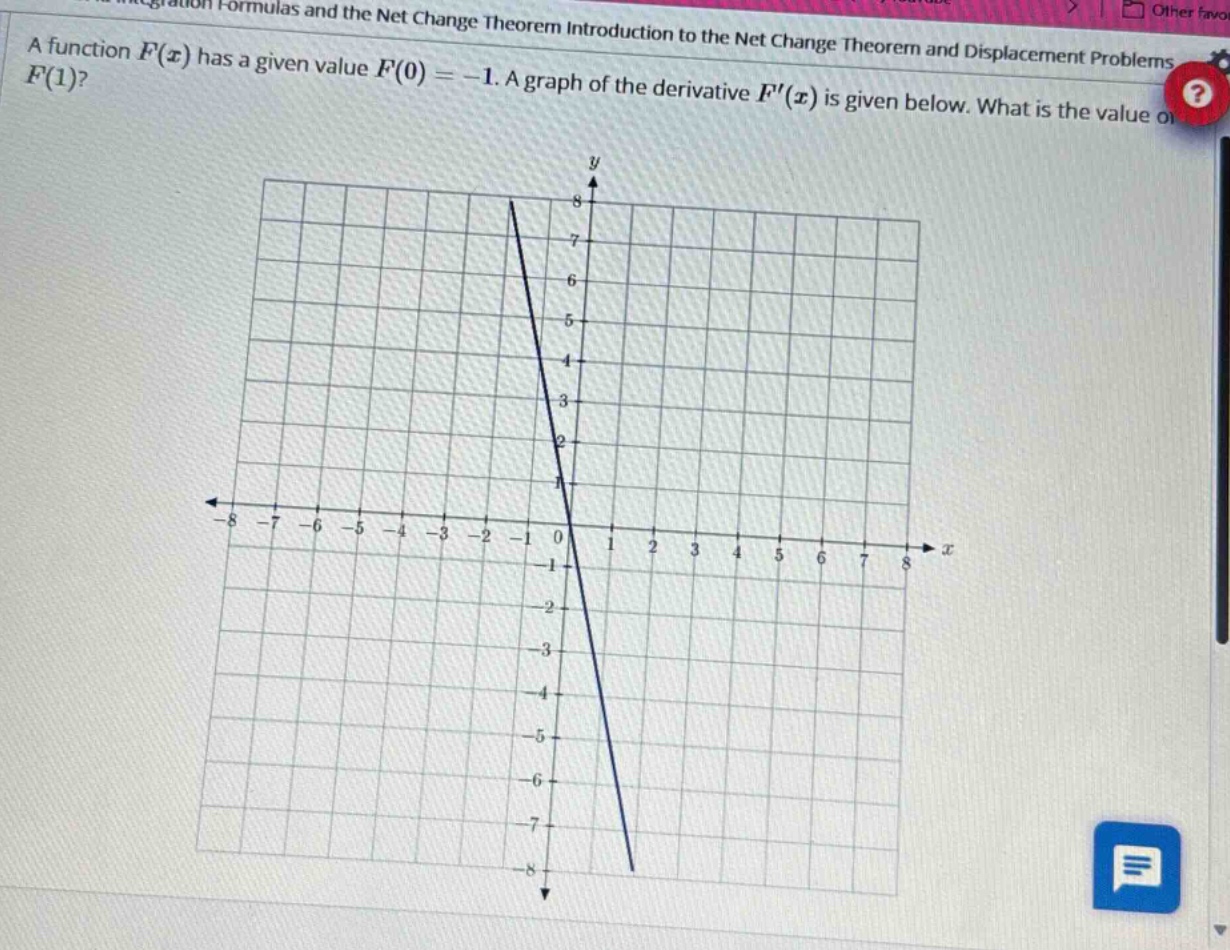
a function $f(x)$ has a given value $f(0)= - 1$. a graph of the derivative $f(x)$ is given below. what is the value of $f(1)$?
Answer
Explanation:
Step1: Use the Net Change Theorem.
The Net Change Theorem states that the integral of a rate of change gives the net change. We can express $F(1)$ in terms of $F(0)$ and the definite integral of $F'(x)$ from $0$ to $1$: $$F(1) = F(0) + \int_{0}^{1} F'(x) dx$$ We are given $F(0) = -1$.
Step2: Evaluate the definite integral $\int_{0}^{1} F'(x) dx$.
The definite integral $\int_{0}^{1} F'(x) dx$ represents the signed area under the graph of $F'(x)$ from $x=0$ to $x=1$. From the graph, $F'(x)$ is a straight line passing through the points $(0, 2)$ and $(1, -3)$. The equation of the line is $F'(x) = mx + c$. The slope $m = \frac{-3 - 2}{1 - 0} = -5$. The y-intercept is $c = 2$. So, $F'(x) = -5x + 2$. To find the area, we can find the x-intercept where $F'(x) = 0$: $-5x + 2 = 0 \Rightarrow 5x = 2 \Rightarrow x = \frac{2}{5} = 0.4$. The area is composed of two triangles:
- A triangle above the x-axis from $x=0$ to $x=0.4$, with base $0.4$ and height $F'(0)=2$. Area$_1 = \frac{1}{2} \times 0.4 \times 2 = 0.4$.
- A triangle below the x-axis from $x=0.4$ to $x=1$, with base $1 - 0.4 = 0.6$ and height $|F'(1)| = |-3| = 3$. Area$2 = \frac{1}{2} \times 0.6 \times 3 = 0.9$. The definite integral is the signed area: $$\int{0}^{1} F'(x) dx = \text{Area}1 - \text{Area}2 = 0.4 - 0.9 = -0.5$$ Alternatively, we can compute the integral directly: $$\int{0}^{1} (-5x + 2) dx = \left[ -\frac{5x^2}{2} + 2x \right]{0}^{1} = \left( -\frac{5(1)^2}{2} + 2(1) \right) - \left( -\frac{5(0)^2}{2} + 2(0) \right) = -\frac{5}{2} + 2 = -\frac{5}{2} + \frac{4}{2} = -\frac{1}{2} = -0.5$$
Step3: Calculate $F(1)$.
Substitute the values of $F(0)$ and $\int_{0}^{1} F'(x) dx$ into the equation from Step 1: $$F(1) = F(0) + \int_{0}^{1} F'(x) dx$$ $$F(1) = -1 + (-0.5)$$ $$F(1) = -1.5$$
Answer:
$F(1) = -1.5$