the function h gives the height, above the ground, of a point on a spinning wheel. the function a gives the…
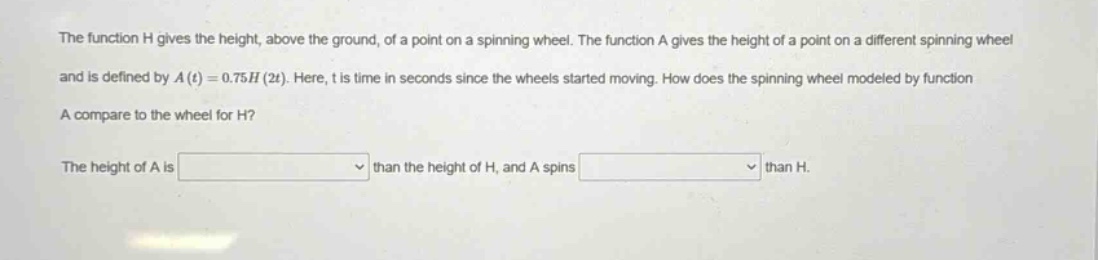
the function h gives the height, above the ground, of a point on a spinning wheel. the function a gives the height of a point on a different spinning wheel and is defined by a(t)=0.75h(2t). here, t is time in seconds since the wheels started moving. how does the spinning wheel modeled by function a compare to the wheel for h? the height of a is than the height of h, and a spins than h.
Answer
Explanation:
Step1: Analyze the coefficient of H
The function $A(t)=0.75H(2t)$. The coefficient 0.75 in front of $H$ means that for the same input $t$ (after considering the transformation inside $H$), the output values of $A$ are 0.75 times the output values of $H$. So the height of $A$ is lower than the height of $H$.
Step2: Analyze the argument of H
The argument of $H$ in $A(t)$ is $2t$. For a periodic - like function (which is likely for the height of a spinning wheel), if we consider the general form of a periodic function $y = f(Bx)$ where $B> 1$, the period of $y = f(Bx)$ is $\frac{T}{B}$ compared to the period $T$ of $y = f(x)$. Here $B = 2$, so the period of $A$ is half of the period of $H$. A shorter period means the wheel modeled by $A$ spins faster.
Answer:
The height of A is lower than the height of H, and A spins faster than H.