for the function f(x)=5 + 4/(x - 3)^2, (a) graph the rational function using transformations, (b) use the…
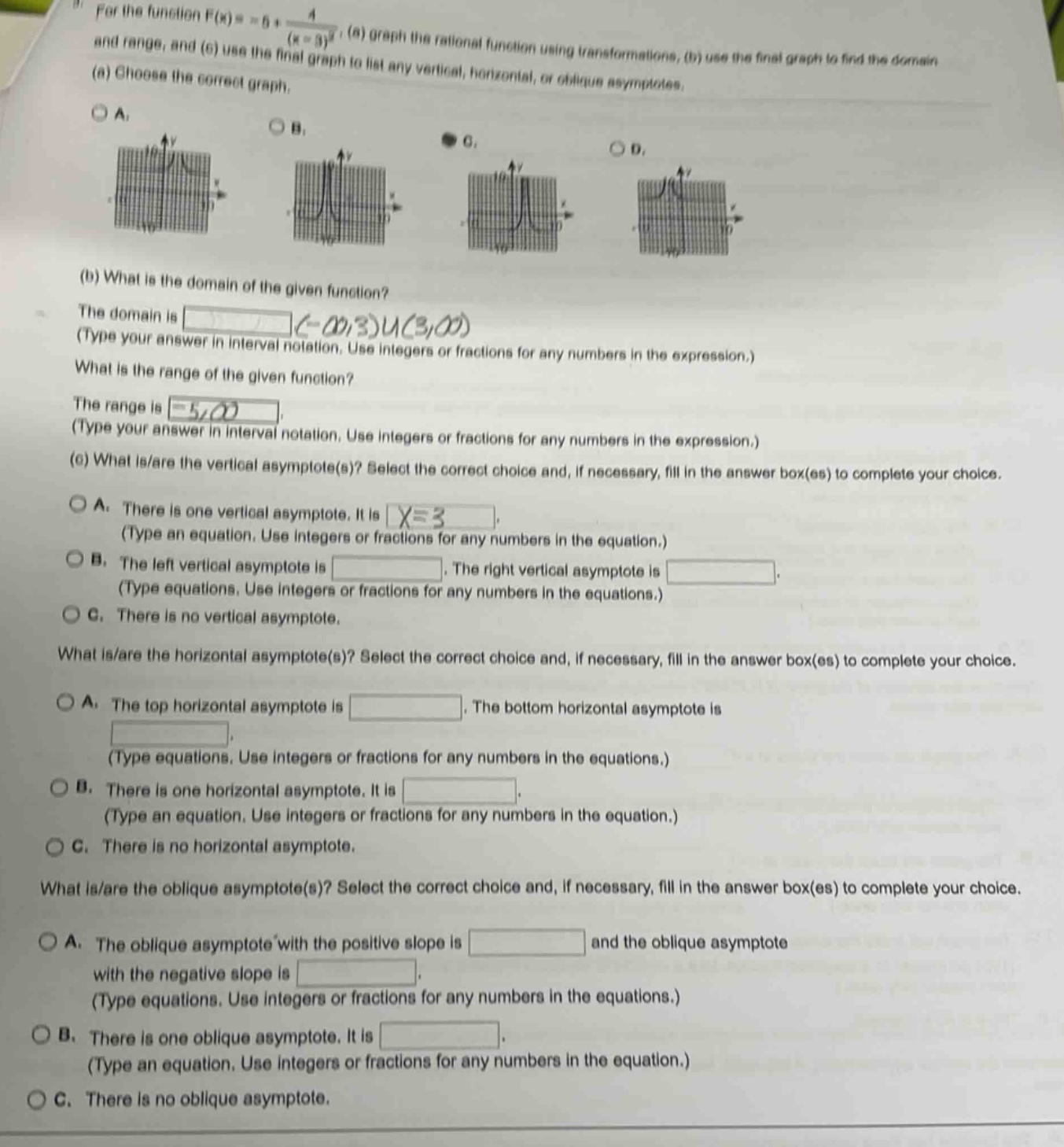
for the function f(x)=5 + 4/(x - 3)^2, (a) graph the rational function using transformations, (b) use the final graph to find the domain and range, and (c) use the final graph to list any vertical, horizontal, or oblique asymptotes. (a) choose the correct graph. (b) what is the domain of the given function? the domain is (-∞,3)u(3,∞) (type your answer in interval notation. use integers or fractions for any numbers in the expression.) what is the range of the given function? the range is 5,∞) (type your answer in interval notation. use integers or fractions for any numbers in the expression.) (c) what is/are the vertical asymptote(s)? select the correct choice and, if necessary, fill in the answer box(es) to complete your choice. a. there is one vertical asymptote. it is x = 3 (type an equation. use integers or fractions for any numbers in the equation.) b. the left vertical asymptote is. the right vertical asymptote is (type equations. use integers or fractions for any numbers in the equations.) c. there is no vertical asymptote. what is/are the horizontal asymptote(s)? select the correct choice and, if necessary, fill in the answer box(es) to complete your choice. a. the top horizontal asymptote is. the bottom horizontal asymptote is (type equations. use integers or fractions for any numbers in the equations.) b. there is one horizontal asymptote. it is (type an equation. use integers or fractions for any numbers in the equation.) c. there is no horizontal asymptote. what is/are the oblique asymptote(s)? select the correct choice and, if necessary, fill in the answer box(es) to complete your choice. a. the oblique asymptote with the positive slope is and the oblique asymptote with the negative slope is (type equations. use integers or fractions for any numbers in the equations.) b. there is one oblique asymptote. it is (type an equation. use integers or fractions for any numbers in the equation.) c. there is no oblique asymptote.
Answer
Explanation:
Step1: Analyze the domain
The function is $F(x)=5+\frac{4}{(x - 3)^2}$. The denominator of a rational - function cannot be zero. Set $(x - 3)^2=0$, we get $x = 3$. So the domain is all real numbers except $x = 3$, which is $(-\infty,3)\cup(3,\infty)$ in interval notation.
Step2: Analyze the range
Since $(x - 3)^2>0$ for all $x\neq3$, then $\frac{4}{(x - 3)^2}>0$. So $F(x)=5+\frac{4}{(x - 3)^2}>5$. The range is $(5,\infty)$ in interval notation.
Step3: Analyze vertical asymptotes
Set the denominator equal to zero. For $y = 5+\frac{4}{(x - 3)^2}$, when $(x - 3)^2=0$ (i.e., $x = 3$), the function has a vertical asymptote. The equation of the vertical asymptote is $x = 3$.
Step4: Analyze horizontal asymptotes
As $x\to\pm\infty$, $\frac{4}{(x - 3)^2}\to0$. So $y = 5+\frac{4}{(x - 3)^2}\to5$. The equation of the horizontal asymptote is $y = 5$.
Step5: Analyze oblique asymptotes
Since the degree of the numerator is less than the degree of the denominator (the numerator of the rational part is a constant and the denominator is a non - zero quadratic), there are no oblique asymptotes.
Answer:
(b) Domain: $(-\infty,3)\cup(3,\infty)$ Range: $(5,\infty)$ (c) Vertical asymptote: A. $x = 3$ Horizontal asymptote: B. $y = 5$ Oblique asymptote: C. There is no oblique asymptote.