the function y = f(x) is graphed below. what is the average rate of change of the function f(x) on the…
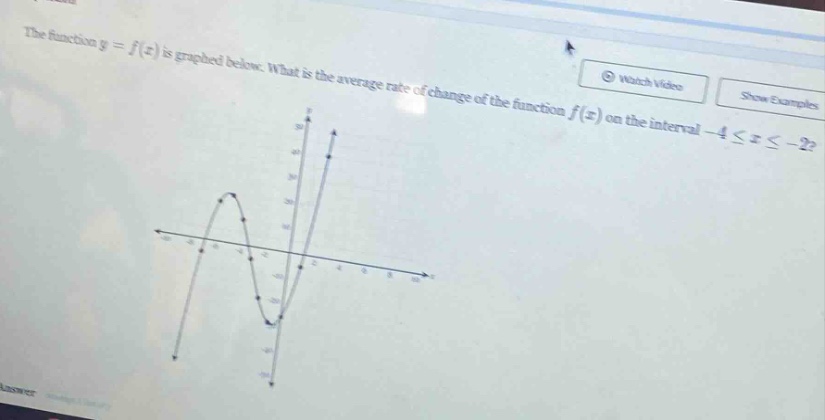
the function y = f(x) is graphed below. what is the average rate of change of the function f(x) on the interval -4 ≤ x ≤ -2?
Answer
Answer:
To find the average rate of change of the function (y = f(x)) on the interval ([a,b]=[-4,-2]), we use the formula (\text{Average rate of change}=\frac{f(b)-f(a)}{b - a}).
- First, we need to find (f(-4)) and (f(-2)) from the graph.
- Locate (x=-4) on the (x -)axis and then find the corresponding (y -)value on the graph, say (y_1 = f(-4)).
- Locate (x = - 2) on the (x -)axis and then find the corresponding (y -)value on the graph, say (y_2=f(-2)).
- Then, calculate the average rate of change:
- The average rate of change of (y = f(x)) on the interval ([-4,-2]) is (\frac{f(-2)-f(-4)}{-2-(-4)}=\frac{f(-2)-f(-4)}{2}). Since the graph is not provided with specific numerical values for (f(-4)) and (f(-2)) in the text, we leave the answer in this general - formula form for the average rate of change on the given interval. If we assume from the graph that (f(-4)=y_1) and (f(-2)=y_2), the average rate of change is (\frac{y_2 - y_1}{2}).
Explanation:
Step1: Recall the average - rate - of - change formula
The formula for the average rate of change of a function (y = f(x)) on the interval ([a,b]) is (\frac{f(b)-f(a)}{b - a}), where (a=-4) and (b = - 2).
Step2: Identify function values from the graph
We need to find (f(-4)) and (f(-2)) by looking at the graph of the function (y = f(x)).
Step3: Substitute values into the formula
Substitute (a=-4), (b = - 2), (f(-4)) and (f(-2)) into the formula (\frac{f(b)-f(a)}{b - a}) to get (\frac{f(-2)-f(-4)}{-2-(-4)}=\frac{f(-2)-f(-4)}{2}).