the function graphed is of the form y = a sin bx or y = a cos bx, where b > 0. determine the equation of the…
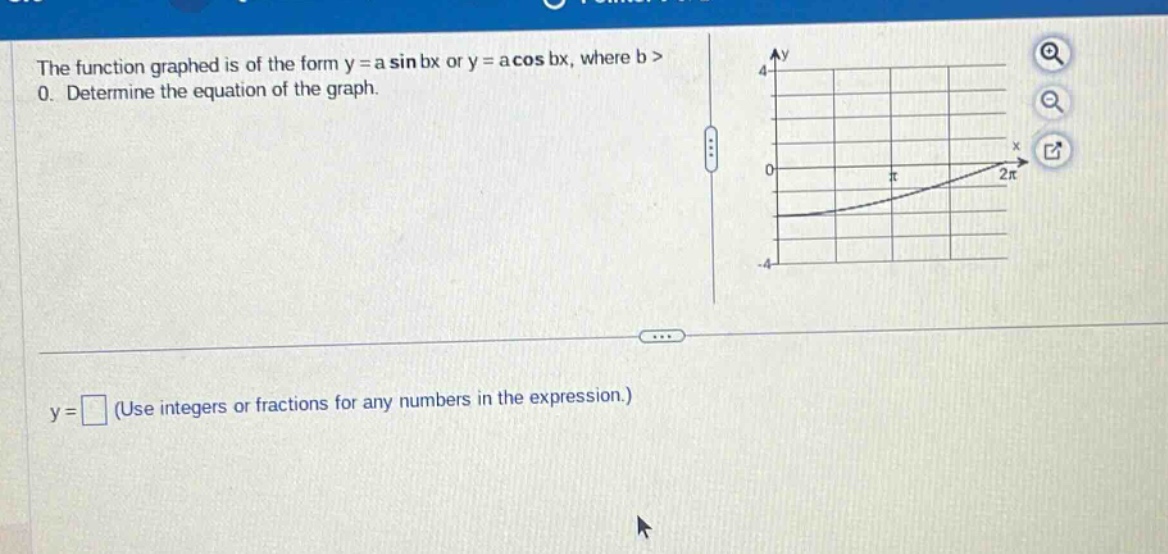
the function graphed is of the form y = a sin bx or y = a cos bx, where b > 0. determine the equation of the graph.\ny = (use integers or fractions for any numbers in the expression.)
Answer
Explanation:
Step1: Determine the amplitude (a)
The amplitude is half the distance between the maximum and minimum values of the function. The maximum value is close to (0) and the minimum value is close to (- 4). So, (a=\frac{0 - (-4)}{2}=2).
Step2: Determine the period (T) and (b)
The period (T) of a sine or cosine function (y = a\sin(bx)) or (y=a\cos(bx)) is given by (T=\frac{2\pi}{b}). From the graph, the period (T = 2\pi). Since (T=\frac{2\pi}{b}=2\pi), then (b = 1).
Step3: Determine the type of function
The function passes through the point ((0,- 2)). For (y=a\sin(bx)), when (x = 0), (y=a\sin(0)=0). For (y=a\cos(bx)), when (x = 0), (y=a\cos(0)=a). Since (a = 2) and the function value at (x = 0) is (-2), the function is (y=-2\cos(x))
Answer:
(y=-2\cos(x))