which function is graphed?\n$y = \\frac{1}{2}\\csc(x)$\n$y = \\csc(\\frac{1}{2}x)$\n$y = \\frac{1}{2}\\sec(x)…
which function is graphed?\n$y = \\frac{1}{2}\\csc(x)$\n$y = \\csc(\\frac{1}{2}x)$\n$y = \\frac{1}{2}\\sec(x)$\n$y = \\sec(\\frac{1}{2}x)$
Answer
Answer:
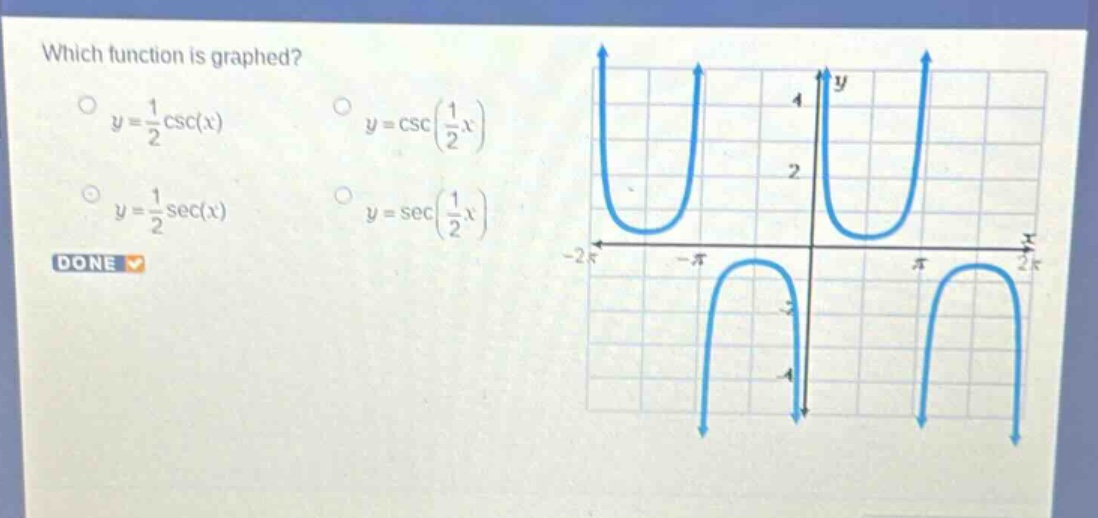
( y = \frac{1}{2}\sec(x) )
Explanation:
Step1: Analyze the type of trigonometric function
The general form of ( y = A\sec(Bx) ) or ( y = A\csc(Bx) ). The graph has vertical asymptotes at ( x=(2n + 1)\frac{\pi}{2},n\in\mathbb{Z} ), which is a characteristic of the ( y=\sec(x) ) function (since ( y = \csc(x) ) has vertical asymptotes at ( x=n\pi,n\in\mathbb{Z} )). So we can eliminate the ( \csc ) - related options (( y=\frac{1}{2}\csc(x) ) and ( y=\csc(\frac{1}{2}x) )).
Step2: Analyze the period and amplitude
The period of ( y = A\sec(Bx) ) is ( T=\frac{2\pi}{|B|} ). For ( y=\sec(\frac{1}{2}x) ), ( T = \frac{2\pi}{\frac{1}{2}}=4\pi ). For ( y=\frac{1}{2}\sec(x) ), ( T = 2\pi ). Looking at the graph, the period is ( 2\pi ). Also, the range of ( y=\frac{1}{2}\sec(x) ) is ( (-\infty,-\frac{1}{2}]\cup[\frac{1}{2},\infty) ) (since ( |A|=\frac{1}{2} ) in ( y = A\sec(x) )), which is consistent with the graph. So the function is ( y=\frac{1}{2}\sec(x) ).