the function $f(x)=-2^{x + 4}+3$ is graphed below. plot all lattice points of the inverse. use the labeled…
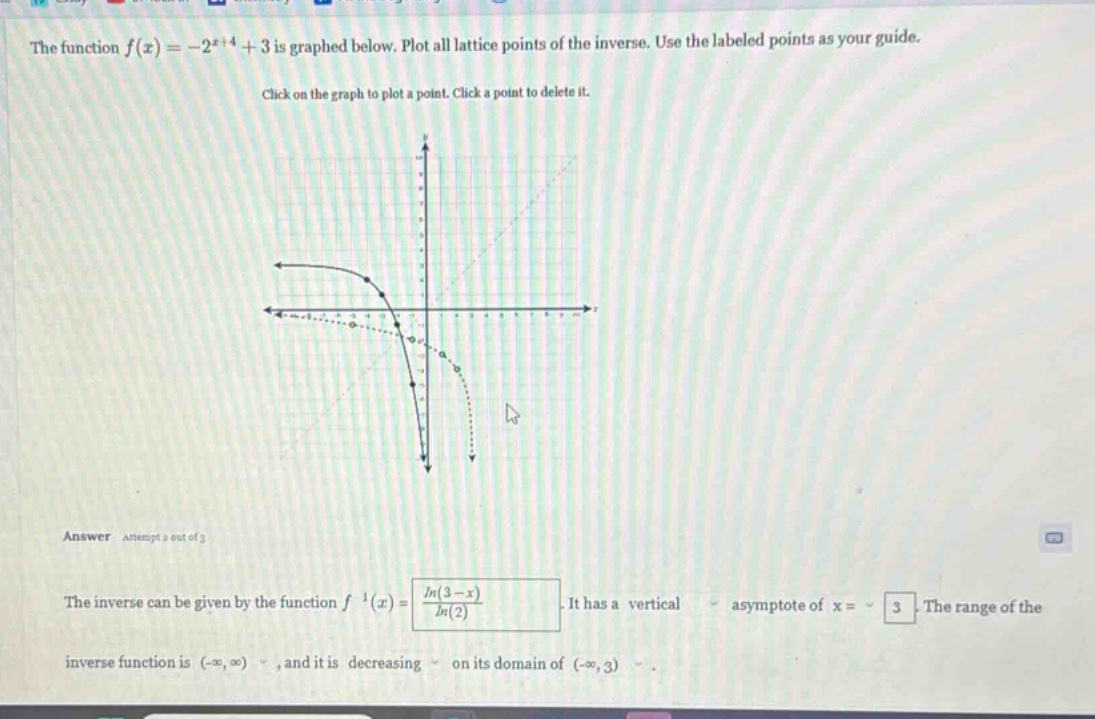
the function $f(x)=-2^{x + 4}+3$ is graphed below. plot all lattice points of the inverse. use the labeled points as your guide. click on the graph to plot a point. click a point to delete it. answer attempt 2 out of 3 the inverse can be given by the function $f^{-1}(x)=\frac{ln(3 - x)}{ln(2)}$. it has a vertical asymptote of $x = 3$. the range of the inverse function is $(-infty,infty)$, and it is decreasing on its domain of $(-infty,3)$.
Answer
Explanation:
Step1: Recall property of inverse - function points
If ((a,b)) is on (y = f(x)), then ((b,a)) is on (y = f^{-1}(x)).
Step2: Identify lattice - points on (y = f(x))
Lattice points are points with integer coordinates. Let's assume some lattice - points on (y=-2^{x + 4}+3). For example, when (x=-4), (y=-2^{-4 + 4}+3=-1 + 3=2). So the point ((-4,2)) is on (y = f(x)), and the point ((2,-4)) is on (y = f^{-1}(x)). When (x=-3), (y=-2^{-3 + 4}+3=-2 + 3 = 1). So the point ((-3,1)) is on (y = f(x)), and the point ((1,-3)) is on (y = f^{-1}(x)). When (x=-5), (y=-2^{-5 + 4}+3=-\frac{1}{2}+3=\frac{5}{2}) (not a lattice - point). We continue this process for all the labeled points on (y = f(x)) and swap their (x) and (y) coordinates to get the lattice - points of (y = f^{-1}(x)).
Answer:
Plot the points obtained by swapping the (x) and (y) coordinates of the lattice - points on (y = f(x)) on the graph of (y = f^{-1}(x)). For example, if ((x_1,y_1)) is a lattice - point on (y = f(x)), plot ((y_1,x_1)) on the inverse function graph.