the function graphed to the right is of the form y = a sec bx + c or y = a csc bx + c for some a≠0, b>0…
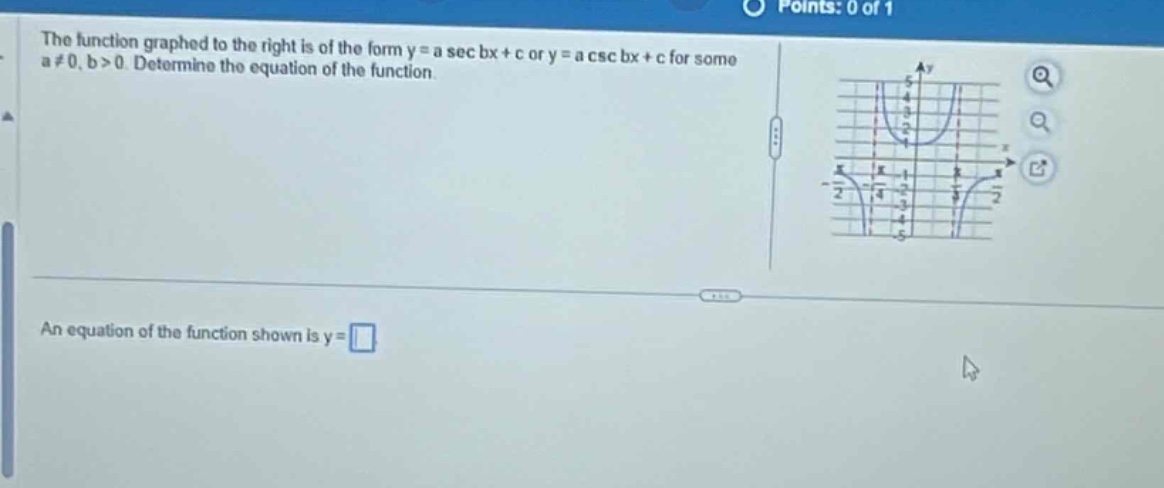
the function graphed to the right is of the form y = a sec bx + c or y = a csc bx + c for some a≠0, b>0. determine the equation of the function. an equation of the function shown is y =
Answer
Explanation:
Step1: Identify the type of function
The graph has vertical asymptotes and U - shaped curves, which is characteristic of a secant function. So the function is of the form $y = a\sec(bx)+c$.
Step2: Find the vertical shift $c$
The mid - line of the graph of $y = a\sec(bx)+c$ is the horizontal line that the graph oscillates around. The mid - line of the given graph is $y = 1$, so $c = 1$.
Step3: Find the period and $b$
The period of $y=\sec(bx)$ is given by $T=\frac{2\pi}{b}$. The distance between two consecutive vertical asymptotes is the period. From the graph, the distance between two consecutive vertical asymptotes is $\pi$. So, $\frac{2\pi}{b}=\pi$. Solving for $b$ gives $b = 2$.
Step4: Find the amplitude $a$
For $y = a\sec(bx)+c$, when $x = 0$, $y=3$. Substituting $x = 0$, $y = 3$, $b = 2$ and $c = 1$ into $y=a\sec(bx)+c$, we get $3=a\sec(0)+1$. Since $\sec(0)=1$, then $3=a\times1 + 1$, which gives $a = 2$.
Answer:
$y = 2\sec(2x)+1$