the function graphed to the right is of the form y = a sin bx or y = a cos bx, where b > 0. determine the…
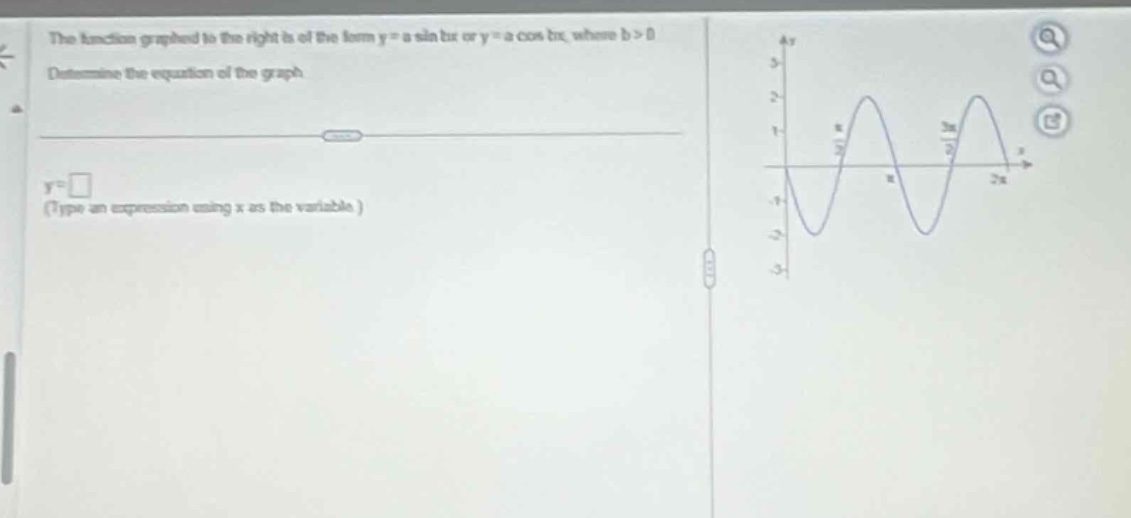
the function graphed to the right is of the form y = a sin bx or y = a cos bx, where b > 0. determine the equation of the graph.\ny = □\n(type an expression using x as the variable.)
Answer
Explanation:
Step1: Determine the amplitude
The graph oscillates between - 3 and 3. The amplitude $a$ of a function $y = a\sin(bx)$ or $y=a\cos(bx)$ is given by $|a|$. Here, $a = 3$ since the maximum value of the function is 3 and the minimum is - 3.
Step2: Determine the period
The period $T$ of the function is the distance between two consecutive peaks or troughs. From the graph, the period $T=\pi$. The formula for the period of $y = a\sin(bx)$ or $y=a\cos(bx)$ is $T=\frac{2\pi}{b}$. Since $T = \pi$, we have $\pi=\frac{2\pi}{b}$. Solving for $b$ gives $b = 2$.
Step3: Determine the type of function
The graph passes through the origin $(0,0)$. The function $y = a\sin(bx)$ passes through the origin and $y=a\cos(bx)$ has a $y -$intercept of $a$. So the function is of the form $y=a\sin(bx)$.
Answer:
$y = 3\sin(2x)$