for each function graphed below, state whether it is one - to - one.\ngraph 1\ngraph 2\ngraph 3\none - to…
for each function graphed below, state whether it is one - to - one.\ngraph 1\ngraph 2\ngraph 3\none - to - one?\nyes no\nyes no\nyes no\ngraph 4\ngraph 5\ngraph 6\none - to - one?\nyes no\nyes no\nyes no
Answer
Explanation:
Graph 1
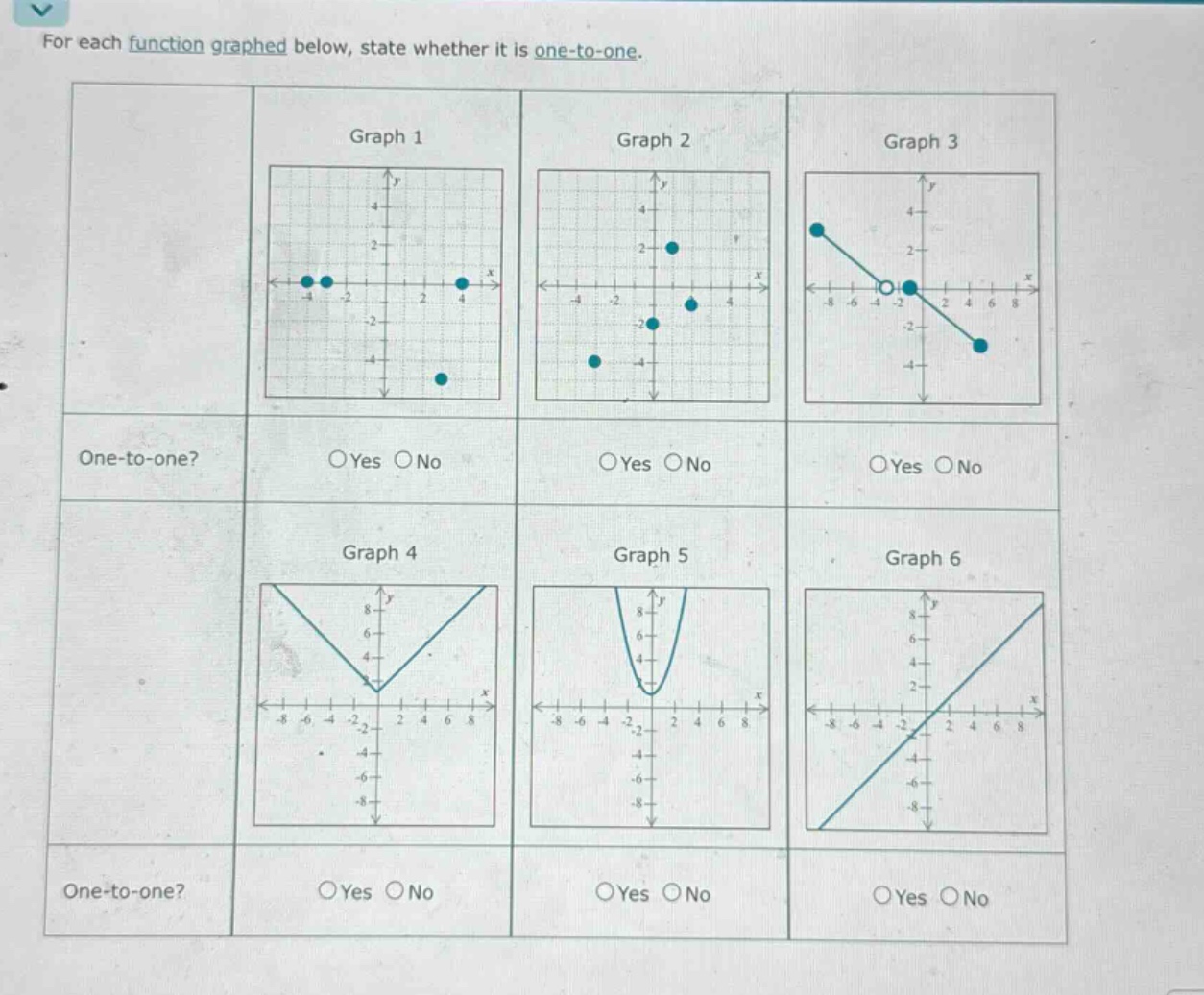
A function is one - to - one if no two different (x) - values have the same (y) - value. In Graph 1, there are two points with the same (y = 0) (the points near (x=-4) and (x = - 3)).
Graph 2
There are two points with the same (y) - value (for example, we can observe that the (y) - values repeat).
Graph 3
For every (y) - value, there is a unique (x) - value. If we assume the function is defined as a piece - wise linear function (based on the graph's structure), no two different (x) values give the same (y) value.
Graph 4
It is a V - shaped graph (like (y=\vert x - a\vert + b)). For example, (y = 2) (assuming the vertex is at ((0,2))) will have two (x) - values ((x=-2) and (x = 2) in a standard (y=\vert x\vert+2) - like graph) that give the same (y) - value.
Graph 5
It is a parabola (a quadratic function (y = ax^{2}+bx + c,a>0)). Parabolas are symmetric about their axis of symmetry (x =-\frac{b}{2a}). So, for example, if (x_1) and (x_2) are symmetric about (x =-\frac{b}{2a}), (y(x_1)=y(x_2)).
Graph 6
It is a straight line (a linear function (y=mx + n,m\neq0)). A linear function (y = mx + n) with (m\neq0) is one - to - one. If (y_1=y_2), then (mx_1 + n=mx_2 + n), which implies (mx_1=mx_2) and since (m\neq0), (x_1 = x_2).
Answer:
Graph 1: No, Graph 2: No, Graph 3: Yes, Graph 4: No, Graph 5: No, Graph 6: Yes