does the function have a greater rate of change over the interval 250 ≤ p ≤ 500 or the interval 500 ≤ p ≤…
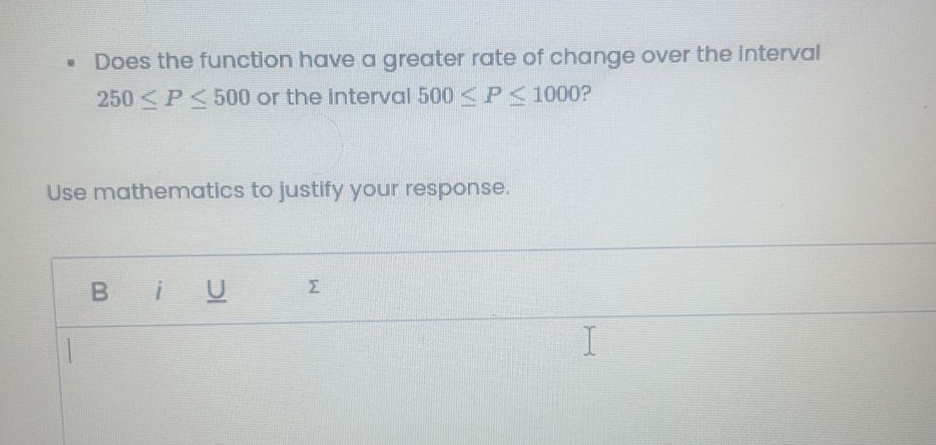
does the function have a greater rate of change over the interval 250 ≤ p ≤ 500 or the interval 500 ≤ p ≤ 1000? use mathematics to justify your response.
Answer
Explanation:
Step1: Recall rate - of - change formula
The average rate of change of a function $y = f(P)$ over the interval $[a,b]$ is $\frac{f(b)-f(a)}{b - a}$.
Step2: Calculate rate of change for interval $250\leq P\leq500$
Let $a = 250$, $b = 500$. The rate of change $r_1=\frac{f(500)-f(250)}{500 - 250}=\frac{f(500)-f(250)}{250}$.
Step3: Calculate rate of change for interval $500\leq P\leq1000$
Let $a = 500$, $b = 1000$. The rate of change $r_2=\frac{f(1000)-f(500)}{1000 - 500}=\frac{f(1000)-f(500)}{500}$.
Step4: Compare $r_1$ and $r_2$
We need to know the values of $f(250)$, $f(500)$ and $f(1000)$. If $r_1>r_2$, the function has a greater rate of change over the interval $250\leq P\leq500$. If $r_1<r_2$, the function has a greater rate of change over the interval $500\leq P\leq1000$. If $r_1 = r_2$, the rates of change are equal.
Since we don't know the function $f(P)$, assume $f(P)=kP + c$ (a linear function for simplicity). Then $f(250)=250k + c$, $f(500)=500k + c$, $f(1000)=1000k + c$. $r_1=\frac{(500k + c)-(250k + c)}{250}=\frac{250k}{250}=k$. $r_2=\frac{(1000k + c)-(500k + c)}{500}=\frac{500k}{500}=k$. In general cases for non - linear functions, we calculate the two rates of change as above and compare the results.
Answer:
We calculate the average rate of change $\frac{f(b)-f(a)}{b - a}$ for each interval ($r_1$ for $250\leq P\leq500$ and $r_2$ for $500\leq P\leq1000$) and then compare $r_1$ and $r_2$. If $r_1>r_2$, the function has a greater rate of change over $250\leq P\leq500$. If $r_1<r_2$, it has a greater rate of change over $500\leq P\leq1000$. If $r_1 = r_2$, the rates of change are equal.