which function has the greatest rate of change over the interval 8 ≤ x ≤ 12?\n(a) (g(x)=5x + 12)\n(b)…
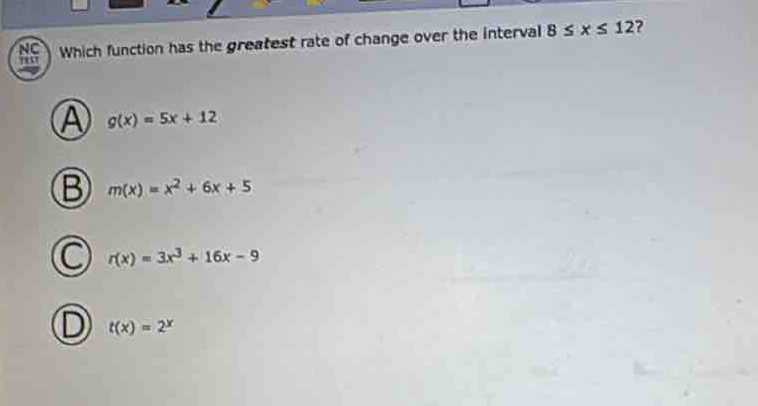
which function has the greatest rate of change over the interval 8 ≤ x ≤ 12?\n(a) (g(x)=5x + 12)\n(b) (m(x)=x^{2}+6x + 5)\n(c) (r(x)=3x^{3}+16x - 9)\n(d) (t(x)=2^{x})
Answer
Explanation:
Step1: Recall rate - of - change formula
The average rate of change of a function $y = f(x)$ over the interval $[a,b]$ is $\frac{f(b)-f(a)}{b - a}$. Here $a = 8$ and $b = 12$.
Step2: Calculate rate of change for $g(x)$
For $g(x)=5x + 12$, $g(12)=5\times12 + 12=60 + 12=72$, $g(8)=5\times8+12 = 40 + 12=52$. The rate of change is $\frac{g(12)-g(8)}{12 - 8}=\frac{72 - 52}{4}=\frac{20}{4}=5$.
Step3: Calculate rate of change for $m(x)$
For $m(x)=x^{2}+6x + 5$, $m(12)=12^{2}+6\times12 + 5=144+72 + 5=221$, $m(8)=8^{2}+6\times8 + 5=64 + 48+5=117$. The rate of change is $\frac{m(12)-m(8)}{12 - 8}=\frac{221 - 117}{4}=\frac{104}{4}=26$.
Step4: Calculate rate of change for $r(x)$
For $r(x)=3x^{3}+16x - 9$, $r(12)=3\times12^{3}+16\times12-9=3\times1728+192 - 9=5184+192 - 9=5367$, $r(8)=3\times8^{3}+16\times8-9=3\times512+128 - 9=1536+128 - 9=1655$. The rate of change is $\frac{r(12)-r(8)}{12 - 8}=\frac{5367 - 1655}{4}=\frac{3712}{4}=928$.
Step5: Calculate rate of change for $t(x)$
For $t(x)=2^{x}$, $t(12)=2^{12}=4096$, $t(8)=2^{8}=256$. The rate of change is $\frac{t(12)-t(8)}{12 - 8}=\frac{4096 - 256}{4}=\frac{3840}{4}=960$.
Answer:
D. $t(x)=2^{x}$