which function has a horizontal asymptote of ( y = 3 )?\n( \bigcirc f(x)=3(2^{x}) )\n( \bigcirc f(x)=2(4)^{x…
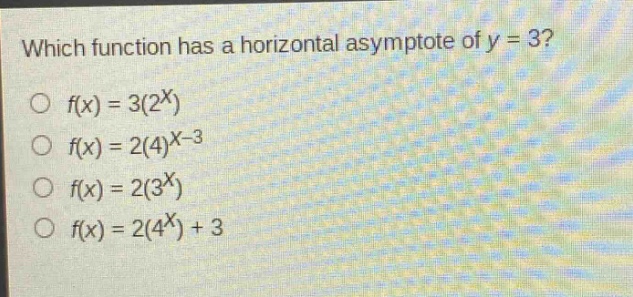
which function has a horizontal asymptote of ( y = 3 )?\n( \bigcirc f(x)=3(2^{x}) )\n( \bigcirc f(x)=2(4)^{x - 3} )\n( \bigcirc f(x)=2(3^{x}) )\n( \bigcirc f(x)=2(4^{x})+3 )
Answer
Explanation:
Step1: Recall the horizontal asymptote rule for exponential functions
For an exponential function of the form (y = a(b)^{x}+c), the horizontal asymptote is (y = c) when (|b|> 0) and (b\neq1).
Step2: Analyze each function
- For (f(x)=3(2^{x})), it is of the form (y = a(b)^{x}) (where (c = 0)). As (x\to-\infty), (y\to0). So the horizontal asymptote is (y = 0).
- For (f(x)=2(4)^{x - 3}), rewrite it as (f(x)=2(4^{- 3})(4)^{x}=\frac{2}{64}(4)^{x}). It is of the form (y=a(b)^{x}) (where (c = 0)). As (x\to-\infty), (y\to0). So the horizontal asymptote is (y = 0).
- For (f(x)=2(3^{x})), it is of the form (y = a(b)^{x}) (where (c = 0)). As (x\to-\infty), (y\to0). So the horizontal asymptote is (y = 0).
- For (f(x)=2(4^{x})+3), it is of the form (y=a(b)^{x}+c) with (a = 2), (b = 4), and (c = 3). As (x\to-\infty), (4^{x}\to0), so (y=2\times0 + 3=3).
Answer:
(f(x)=2(4^{x}) + 3)