which function has a y - intercept of (0, 1) and approaches 0 as x approaches positive infinity?\no a…
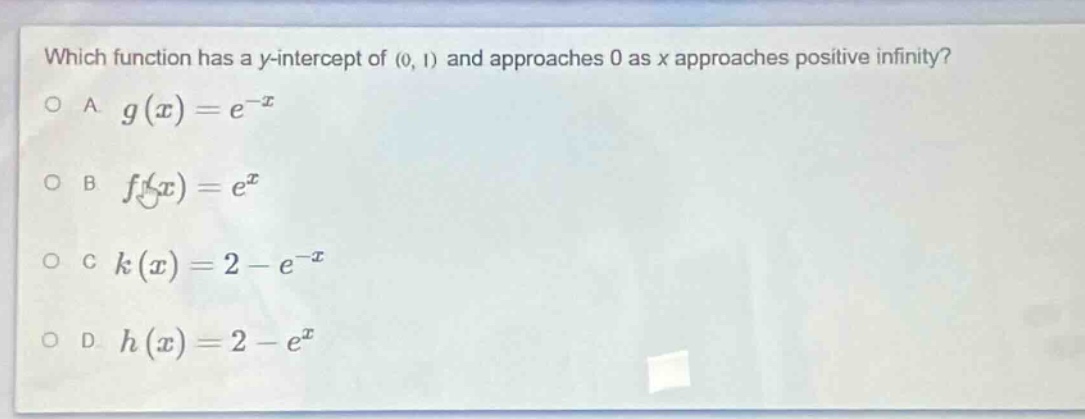
which function has a y - intercept of (0, 1) and approaches 0 as x approaches positive infinity?\no a g(x)=e^(-x)\no b f(x)=e^x\no c k(x)=2 - e^(-x)\no d h(x)=2 - e^x
Answer
Explanation:
Step1: Recall y - intercept formula
The y - intercept of a function $y = f(x)$ is found by setting $x = 0$.
Step2: Check option A
For $g(x)=e^{-x}$, when $x = 0$, $g(0)=e^{-0}=e^{0}=1$. As $x\rightarrow+\infty$, $-x\rightarrow-\infty$, and $\lim_{x\rightarrow+\infty}e^{-x}=\lim_{u\rightarrow-\infty}e^{u}=0$ (let $u=-x$).
Step3: Check option B
For $f(x)=e^{x}$, when $x = 0$, $f(0)=e^{0}=1$, but as $x\rightarrow+\infty$, $\lim_{x\rightarrow+\infty}e^{x}=+\infty$.
Step4: Check option C
For $k(x)=2 - e^{-x}$, when $x = 0$, $k(0)=2 - e^{0}=2 - 1=1$. As $x\rightarrow+\infty$, $\lim_{x\rightarrow+\infty}(2 - e^{-x})=2-\lim_{x\rightarrow+\infty}e^{-x}=2 - 0=2$.
Step5: Check option D
For $h(x)=2 - e^{x}$, when $x = 0$, $h(0)=2 - e^{0}=2 - 1=1$. As $x\rightarrow+\infty$, $\lim_{x\rightarrow+\infty}(2 - e^{x})=2-\lim_{x\rightarrow+\infty}e^{x}=-\infty$.
Answer:
A. $g(x)=e^{-x}$