the function $f(x)=ln(x)$ has been transformed so that there is now a vertical asymptote at $x = - 3$. what…
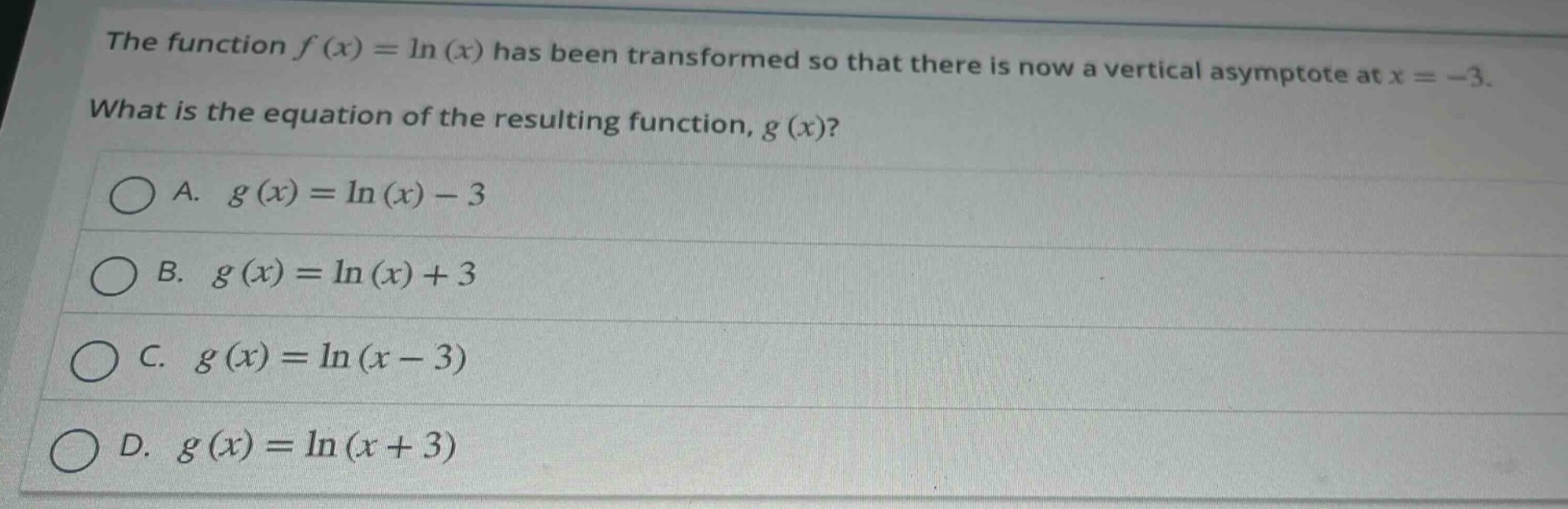
the function $f(x)=ln(x)$ has been transformed so that there is now a vertical asymptote at $x = - 3$. what is the equation of the resulting function, $g(x)$?\na. $g(x)=ln(x)-3$\nb. $g(x)=ln(x)+3$\nc. $g(x)=ln(x - 3)$\nd. $g(x)=ln(x + 3)$
Answer
Explanation:
Step1: Recall vertical - asymptote of ln(x)
The function $y = \ln(x)$ has a vertical asymptote at $x = 0$.
Step2: Analyze horizontal shifts
For a function $y=\ln(x - h)$, the vertical asymptote is at $x=h$. We want the vertical asymptote at $x=-3$.
Step3: Determine the function
If we set $h=-3$ in the function $y = \ln(x - h)$, we get $y=\ln(x-(-3))=\ln(x + 3)$.
Answer:
D. $g(x)=\ln(x + 3)$