the function $p$ models the population of rabbits on a farm and is given by $p(t)=\frac{200t}{1 + 5t}$ for…
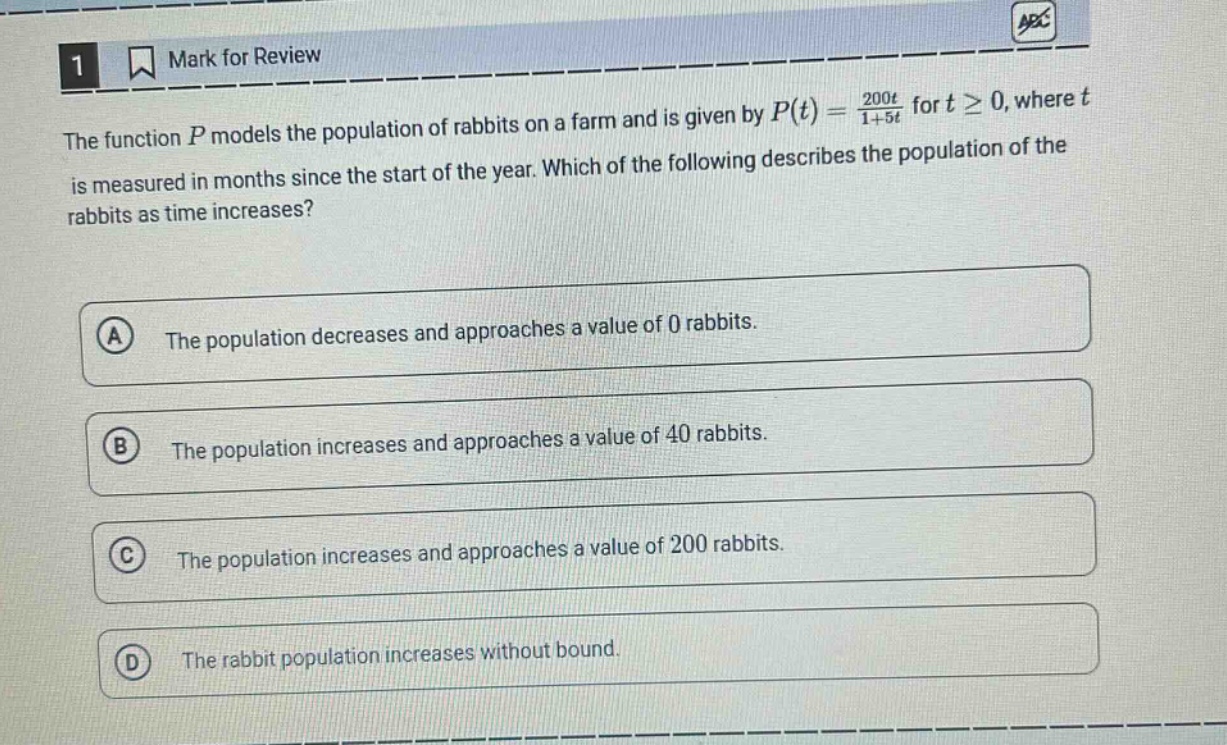
the function $p$ models the population of rabbits on a farm and is given by $p(t)=\frac{200t}{1 + 5t}$ for $tgeq0$, where $t$ is measured in months since the start of the year. which of the following describes the population of the rabbits as time increases?\na the population decreases and approaches a value of 0 rabbits.\nb the population increases and approaches a value of 40 rabbits.\nc the population increases and approaches a value of 200 rabbits.\nd the rabbit population increases without bound.
Answer
Explanation:
Step1: Rewrite the function
Divide both numerator and denominator of $P(t)=\frac{200t}{1 + 5t}$ by $t$ (since $t\geq0$ and for $t>0$), we get $P(t)=\frac{200}{\frac{1}{t}+5}$.
Step2: Analyze the limit as $t$ approaches infinity
As $t\to\infty$, $\frac{1}{t}\to0$. Then $\lim_{t\to\infty}P(t)=\lim_{t\to\infty}\frac{200}{\frac{1}{t}+5}$. Substituting $\frac{1}{t} = 0$ into the function, we have $\lim_{t\to\infty}P(t)=\frac{200}{0 + 5}=40$. Also, for $t_1<t_2$, $P(t_1)-P(t_2)=\frac{200t_1}{1 + 5t_1}-\frac{200t_2}{1 + 5t_2}=\frac{200t_1(1 + 5t_2)-200t_2(1 + 5t_1)}{(1 + 5t_1)(1 + 5t_2)}=\frac{200(t_1 - t_2)}{(1 + 5t_1)(1 + 5t_2)}<0$, so $P(t)$ is an increasing - function.
Answer:
B. The population increases and approaches a value of 40 rabbits.