the function, f(x), is plotted as shown. evaluate the limits, if they exist. if not, write dne. lim x→−1…
the function, f(x), is plotted as shown. evaluate the limits, if they exist. if not, write dne. lim x→−1 f(x)= lim x→3− f(x)= lim x→1 f(x)=
Answer
Explanation:
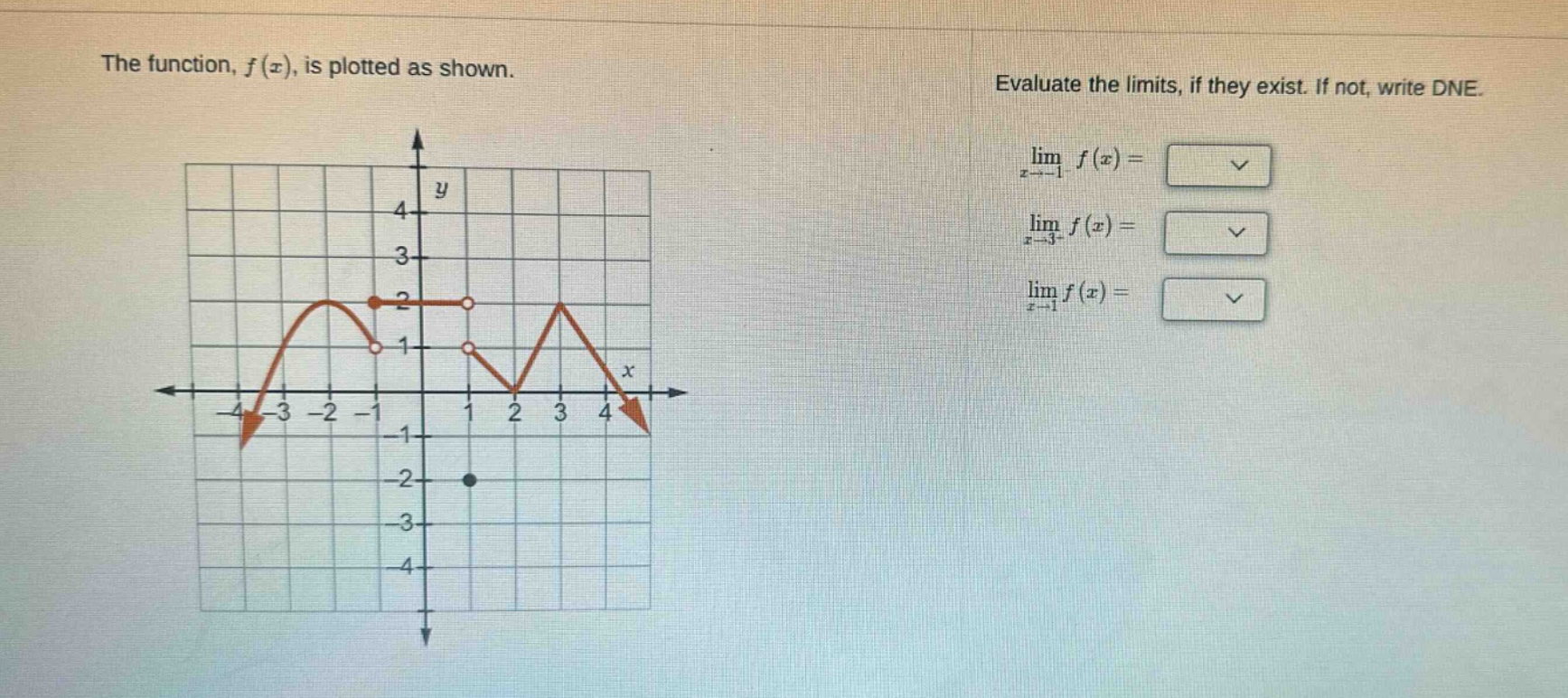
Step1: Analyze $\lim_{x\rightarrow - 1}f(x)$
As $x$ approaches - 1 from both the left - hand side and the right - hand side, the function $f(x)$ approaches 2. So $\lim_{x\rightarrow - 1}f(x)=2$.
Step2: Analyze $\lim_{x\rightarrow 3}f(x)$
As $x$ approaches 3 from the left - hand side, $f(x)$ approaches 1, and as $x$ approaches 3 from the right - hand side, $f(x)$ approaches 1. So $\lim_{x\rightarrow 3}f(x)=1$.
Step3: Analyze $\lim_{x\rightarrow 1}f(x)$
As $x$ approaches 1 from the left - hand side, $f(x)$ approaches 2, and as $x$ approaches 1 from the right - hand side, $f(x)$ approaches 1. Since the left - hand limit and the right - hand limit are not equal, $\lim_{x\rightarrow 1}f(x)$ does not exist, so we write DNE.
Answer:
$\lim_{x\rightarrow - 1}f(x)=2$ $\lim_{x\rightarrow 3}f(x)=1$ $\lim_{x\rightarrow 1}f(x)=DNE$