the function, f(x), is plotted as shown. what values do the limits approach? lim x→−5− f(x)= lim x→−5+ f(x)=…
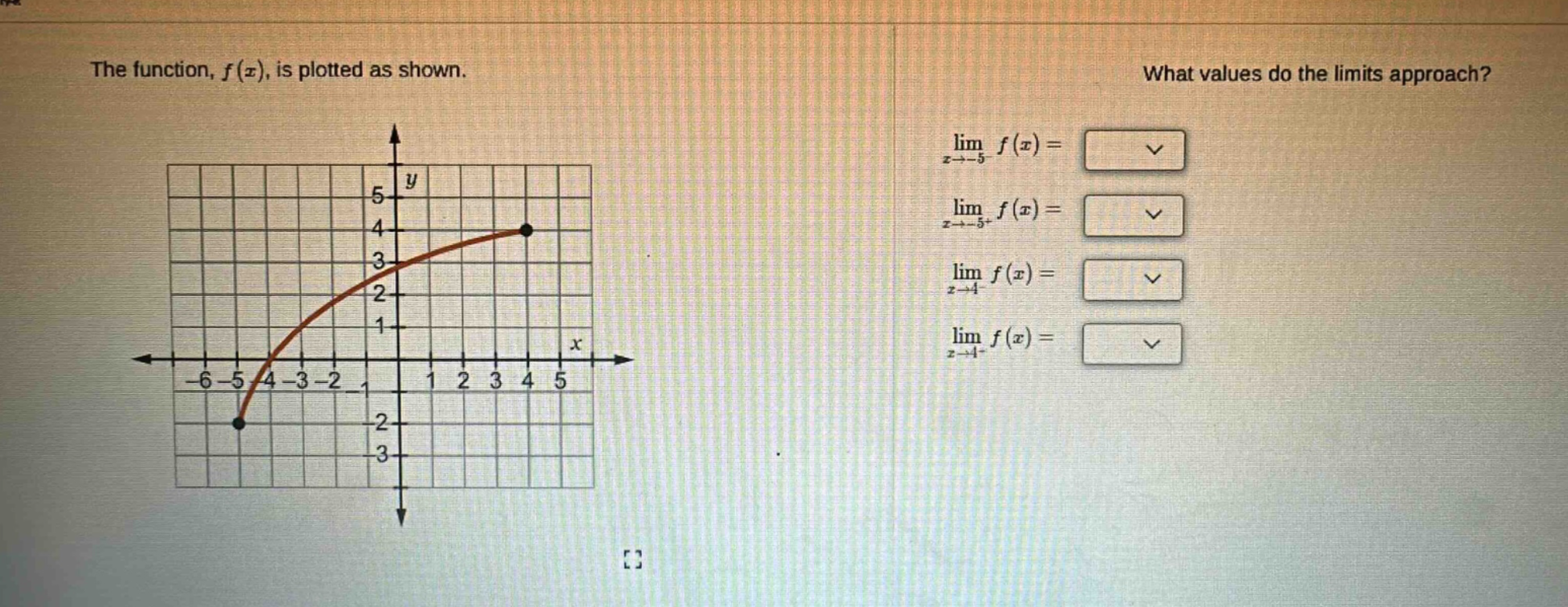
the function, f(x), is plotted as shown. what values do the limits approach? lim x→−5− f(x)= lim x→−5+ f(x)= lim x→4− f(x)= lim x→4+ f(x)=
Answer
Explanation:
Step1: Analyze $\lim_{x\rightarrow - 5^{-}}f(x)$
As $x$ approaches $-5$ from the left - hand side, we look at the values of the function $f(x)$ on the graph for $x < - 5$. The function value approaches $-2$.
Step2: Analyze $\lim_{x\rightarrow - 5^{+}}f(x)$
As $x$ approaches $-5$ from the right - hand side, we look at the values of the function $f(x)$ for $x>-5$ near $x = - 5$. The function value approaches $-2$.
Step3: Analyze $\lim_{x\rightarrow4^{-}}f(x)$
As $x$ approaches $4$ from the left - hand side, we look at the values of the function $f(x)$ for $x < 4$ near $x = 4$. The function value approaches $4$.
Step4: Analyze $\lim_{x\rightarrow4^{+}}f(x)$
As $x$ approaches $4$ from the right - hand side, we look at the values of the function $f(x)$ for $x>4$ near $x = 4$. Since the graph does not extend to the right of $x = 4$, we assume the function value approaches $4$ (if the function is continuous at $x = 4$ from the left - hand side and there is no indication of a break).
Answer:
$\lim_{x\rightarrow - 5^{-}}f(x)=-2$ $\lim_{x\rightarrow - 5^{+}}f(x)=-2$ $\lim_{x\rightarrow4^{-}}f(x)=4$ $\lim_{x\rightarrow4^{+}}f(x)=4$