t(d) is a function that relates the number of tickets sold for a movie to the number of days since the movie…
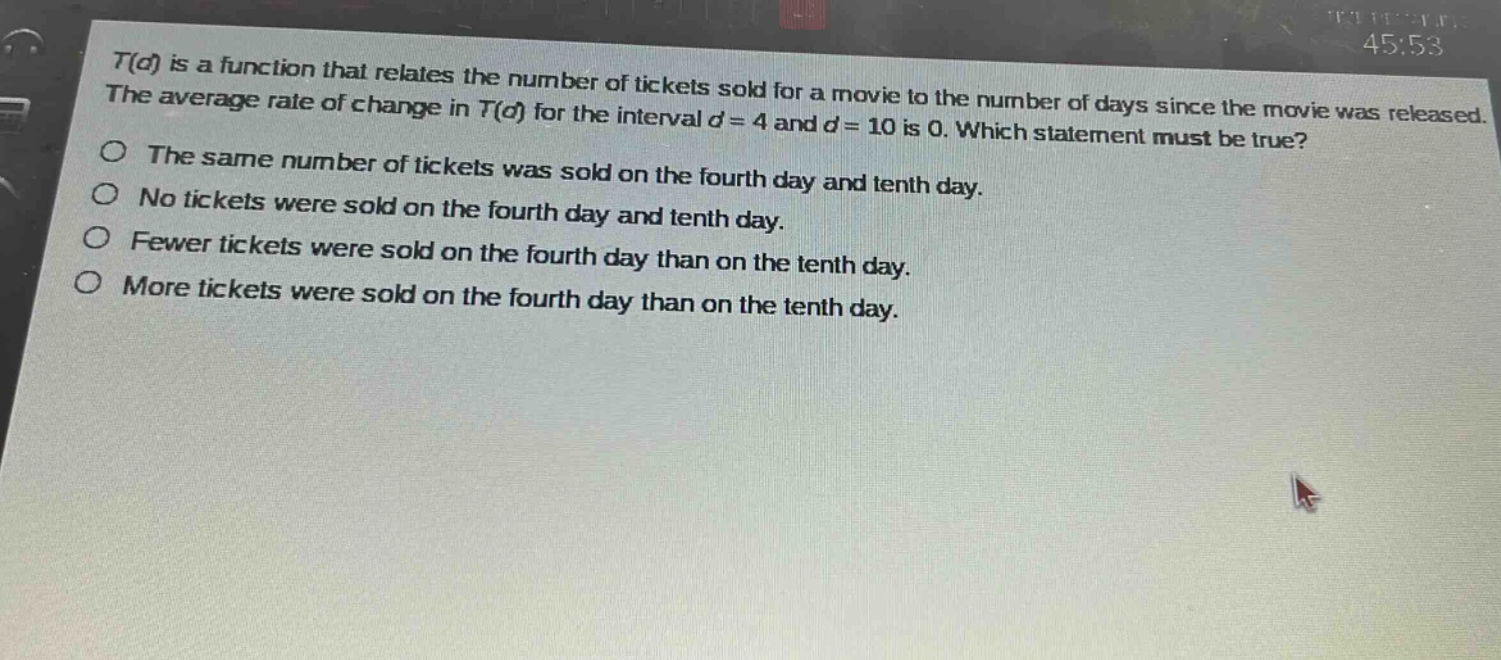
t(d) is a function that relates the number of tickets sold for a movie to the number of days since the movie was released. the average rate of change in t(d) for the interval d = 4 and d = 10 is 0. which statement must be true?\nthe same number of tickets was sold on the fourth day and tenth day.\nno tickets were sold on the fourth day and tenth day.\nfewer tickets were sold on the fourth day than on the tenth day.\nmore tickets were sold on the fourth day than on the tenth day.
Answer
Brief Explanations:
The average rate of change of a function $T(d)$ over the interval $[a,b]$ is given by $\frac{T(b)-T(a)}{b - a}$. If the average rate of change over the interval $d = 4$ to $d=10$ is 0, then $\frac{T(10)-T(4)}{10 - 4}=0$. This implies $T(10)-T(4)=0$, or $T(10)=T(4)$. So the number of tickets sold on the fourth day is the same as the number of tickets sold on the tenth day.
Answer:
The same number of tickets was sold on the fourth day and tenth day.