which function represents y = -tan x?
which function represents y = -tan x?
Answer
Answer:
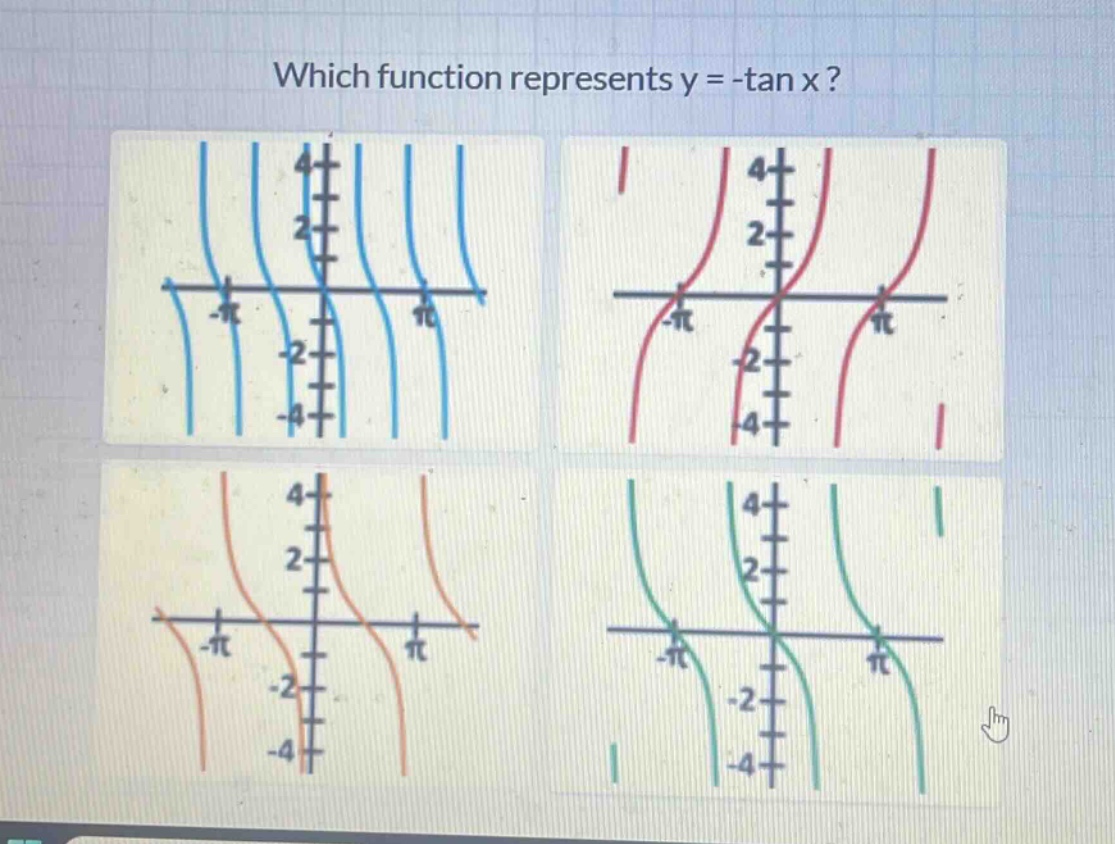
The graph of (y =-\tan x) is the reflection of the graph of (y=\tan x) about the (x -)axis. The tangent function (y = \tan x) has vertical asymptotes at (x=-\frac{\pi}{2}+k\pi,k\in\mathbb{Z}), passes through the origin ((0,0)), and is increasing in each of its intervals ((-\frac{\pi}{2}+k\pi,\frac{\pi}{2}+k\pi)). The function (y =-\tan x) also has vertical asymptotes at (x =-\frac{\pi}{2}+k\pi,k\in\mathbb{Z}), passes through the origin ((0,0)), but is decreasing in each of its intervals ((-\frac{\pi}{2}+k\pi,\frac{\pi}{2}+k\pi)). Among the given graphs, the one that has the correct vertical - asymptote locations and is decreasing in the intervals between the asymptotes and passes through the origin is the correct one. Without seeing the specific labels for each graph, we know that the graph of (y =-\tan x) will have the opposite shape of the graph of (y=\tan x). If we assume the standard orientation of the graphs, the graph that looks like the mirror - image of the typical (y = \tan x) graph across the (x -)axis is the correct representation of (y=-\tan x).
Explanation:
Step1: Recall tangent function properties
The function (y = \tan x=\frac{\sin x}{\cos x}), has vertical asymptotes when (\cos x = 0), i.e., (x=-\frac{\pi}{2}+k\pi,k\in\mathbb{Z}), and passes through ((0,0)).
Step2: Consider the effect of the negative sign
The negative sign in (y =-\tan x) reflects the graph of (y=\tan x) about the (x -)axis. So the increasing intervals of (y=\tan x) become decreasing intervals for (y =-\tan x).