this function, where t represents the time in weeks, models the height, in inches, of the peach tree…
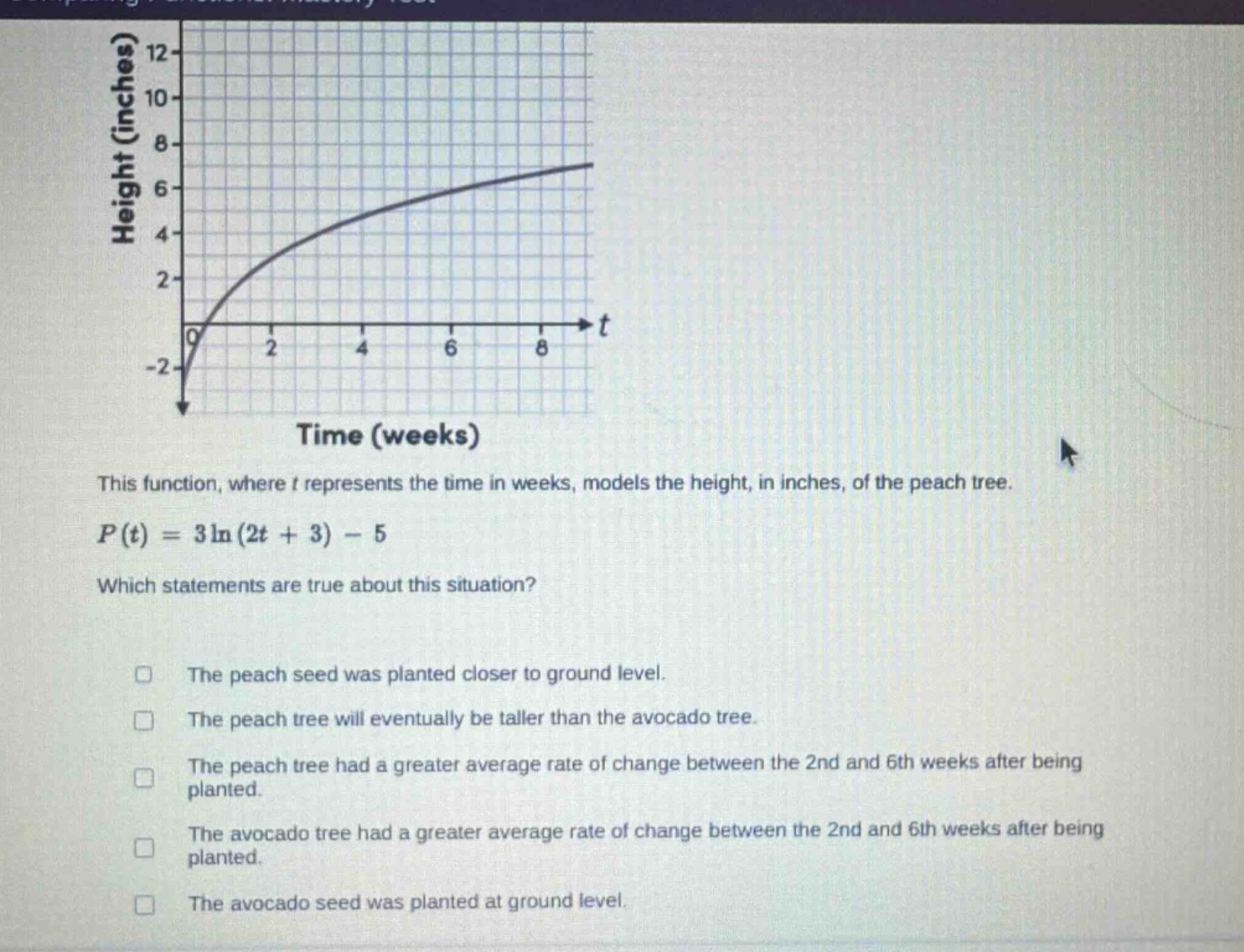
this function, where t represents the time in weeks, models the height, in inches, of the peach tree. p(t)=3ln(2t + 3)-5 which statements are true about this situation? the peach seed was planted closer to ground level. the peach tree will eventually be taller than the avocado tree. the peach tree had a greater average rate of change between the 2nd and 6th weeks after being planted. the avocado tree had a greater average rate of change between the 2nd and 6th weeks after being planted. the avocado seed was planted at ground level.
Answer
Explanation:
Step1: Find the initial height
When (t = 0), (P(0)=3\ln(2\times0 + 3)-5=3\ln(3)-5\approx3\times1.0986 - 5=3.2958-5=- 1.7042). This means the peach - seed was planted below ground level. But we have no information about the avocado - tree's initial height, so we can't say if the avocado seed was planted at ground level or if the peach seed was planted closer to ground level.
Step2: Analyze long - term growth
As (t\to\infty), the function (P(t)=3\ln(2t + 3)-5) will increase without bound since the natural logarithm function (\ln(x)) increases as (x) increases. But we have no information about the avocado - tree's long - term growth, so we can't say if the peach tree will eventually be taller than the avocado tree.
Step3: Calculate the average rate of change
The average rate of change of a function (y = f(x)) from (x=a) to (x = b) is (\frac{f(b)-f(a)}{b - a}). For (P(t)=3\ln(2t + 3)-5), when (a = 2) and (b = 6): First, find (P(2)=3\ln(2\times2+3)-5=3\ln(7)-5\approx3\times1.9459-5 = 5.8377-5=0.8377). Second, find (P(6)=3\ln(2\times6 + 3)-5=3\ln(15)-5\approx3\times2.7081-5=8.1243 - 5=3.1243). The average rate of change from (t = 2) to (t = 6) is (\frac{P(6)-P(2)}{6 - 2}=\frac{3.1243 - 0.8377}{4}=\frac{2.2866}{4}=0.57165). Since we have no information about the avocado - tree's average rate of change between the 2nd and 6th weeks, we can't compare the two.
Since we have no information about the avocado - tree in the problem statement, we can't determine the truth of any of the statements.
Answer:
There is not enough information to determine which statements are true.