for the function shown below, find (if the quantity exists) (a) lim f(x), (b) lim f(x), (c) lim f(x), and…
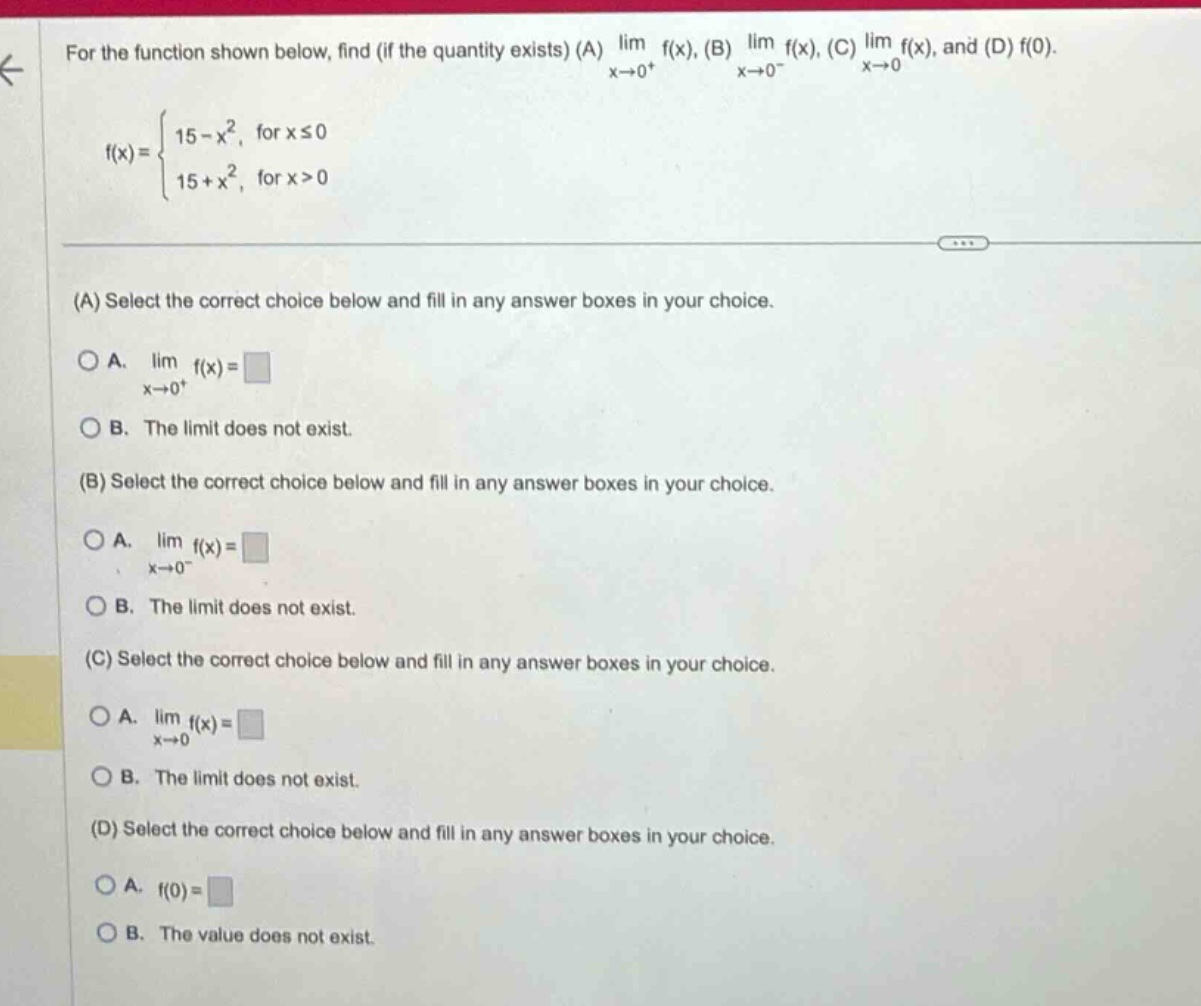
for the function shown below, find (if the quantity exists) (a) lim f(x), (b) lim f(x), (c) lim f(x), and (d) f(0). x→0+ x→0− x→0 f(x)={15 - x², for x ≤ 0; 15 + x², for x > 0} (a) select the correct choice below and fill in any answer boxes in your choice. a. lim f(x)=□ x→0+ b. the limit does not exist. (b) select the correct choice below and fill in any answer boxes in your choice. a. lim f(x)=□ x→0− b. the limit does not exist. (c) select the correct choice below and fill in any answer boxes in your choice. a. lim f(x)=□ x→0 b. the limit does not exist. (d) select the correct choice below and fill in any answer boxes in your choice. a. f(0)=□ b. the value does not exist.
Answer
Explanation:
Step1: Find right - hand limit
For $x\to0^{+}$, use $f(x)=15 + x^{2}$. Substitute $x = 0$ into $15 + x^{2}$. $\lim_{x\to0^{+}}f(x)=\lim_{x\to0^{+}}(15 + x^{2})=15+0^{2}=15$
Step2: Find left - hand limit
For $x\to0^{-}$, use $f(x)=15 - x^{2}$. Substitute $x = 0$ into $15 - x^{2}$. $\lim_{x\to0^{-}}f(x)=\lim_{x\to0^{-}}(15 - x^{2})=15-0^{2}=15$
Step3: Find overall limit
Since $\lim_{x\to0^{+}}f(x)=\lim_{x\to0^{-}}f(x)=15$, then $\lim_{x\to0}f(x)=15$.
Step4: Find $f(0)$
For $x = 0$, use $f(x)=15 - x^{2}$ (because $x = 0$ satisfies $x\leq0$). Substitute $x = 0$ into $15 - x^{2}$. $f(0)=15-0^{2}=15$
Answer:
(A) A. $\lim_{x\to0^{+}}f(x)=15$ (B) A. $\lim_{x\to0^{-}}f(x)=15$ (C) A. $\lim_{x\to0}f(x)=15$ (D) A. $f(0)=15$