the function ( f(x) ) is shown on the graph. if ( f(x)=0 ), what is ( x )? 0 only -6 only -2, 1, or 3 only…
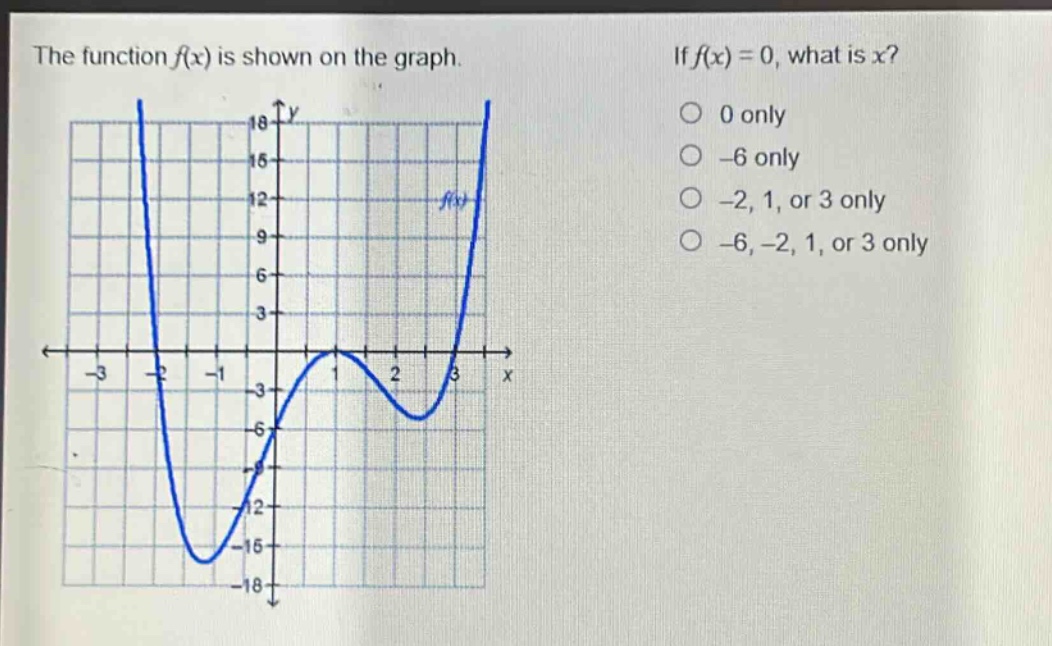
the function ( f(x) ) is shown on the graph. if ( f(x)=0 ), what is ( x )? 0 only -6 only -2, 1, or 3 only -6, -2, 1, or 3 only
Answer
Explanation:
Step1: Understand the meaning of (f(x) = 0)
When (f(x)=0), we are looking for the (x -)values where the graph of the function (y = f(x)) intersects the (x -)axis (since (y=f(x)) and (y = 0) on the (x -)axis).
Step2: Identify the (x -)intercepts from the graph
The (x -)intercepts are the points ((x,0)) on the graph of (y = f(x)). Looking at the graph, the function (y = f(x)) intersects the (x -)axis at (x=-2), (x = 1), and (x=3).
Answer:
(-2), (1), or (3) only.