a function is shown in the table below. on which interval of x is the average rate of change of the function…
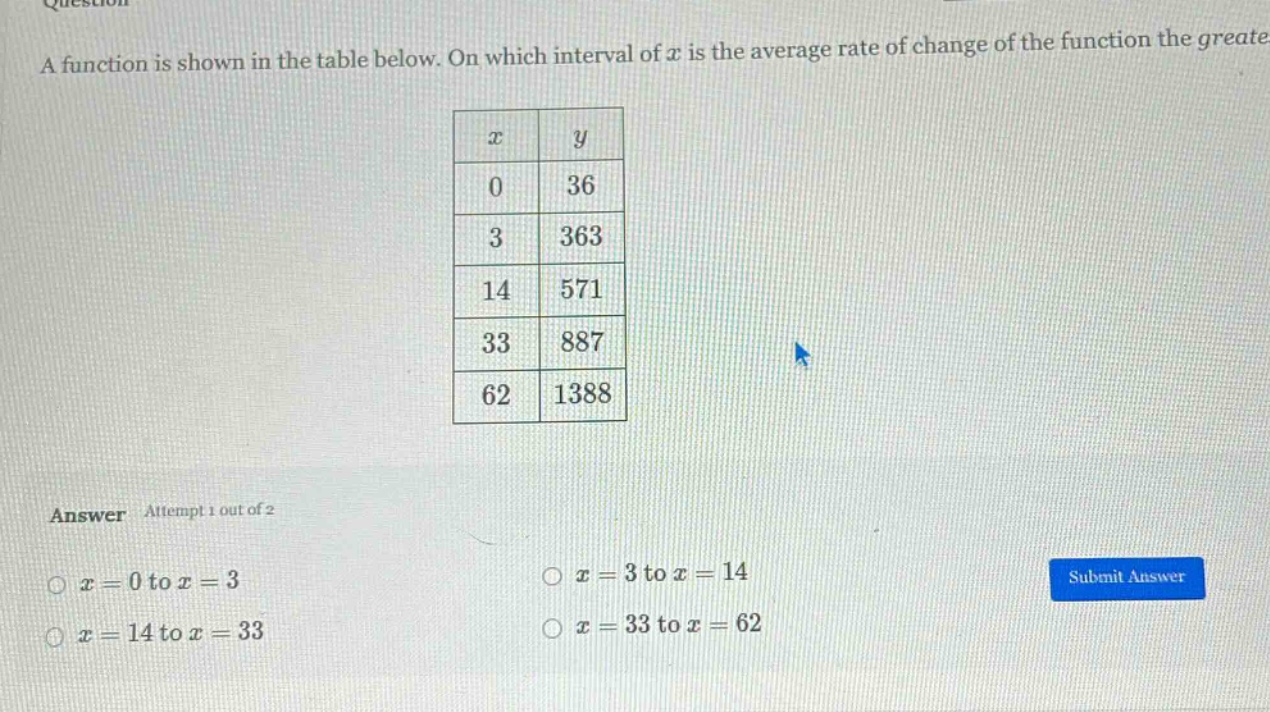
a function is shown in the table below. on which interval of x is the average rate of change of the function the greatest?\nanswer attempt 1 out of 2\nx = 0 to x = 3\nx = 3 to x = 14\nx = 14 to x = 33\nx = 33 to x = 62\nsubmit answer\n\n| x | y |\n|----|----|\n| 0 | 36 |\n| 3 | 363 |\n| 14 | 571 |\n| 33 | 887 |\n| 62 | 1388 |
Answer
Explanation:
Step1: Recall average - rate - of - change formula
The average rate of change of a function $y = f(x)$ over the interval $[a,b]$ is $\frac{f(b)-f(a)}{b - a}$.
Step2: Calculate rate for $x = 0$ to $x = 3$
Let $a = 0$, $b = 3$, $f(0)=36$, $f(3)=363$. Then $\frac{f(3)-f(0)}{3 - 0}=\frac{363 - 36}{3}=\frac{327}{3}=109$.
Step3: Calculate rate for $x = 3$ to $x = 14$
Let $a = 3$, $b = 14$, $f(3)=363$, $f(14)=571$. Then $\frac{f(14)-f(3)}{14 - 3}=\frac{571 - 363}{11}=\frac{208}{11}\approx18.91$.
Step4: Calculate rate for $x = 14$ to $x = 33$
Let $a = 14$, $b = 33$, $f(14)=571$, $f(33)=887$. Then $\frac{f(33)-f(14)}{33 - 14}=\frac{887 - 571}{19}=\frac{316}{19}\approx16.63$.
Step5: Calculate rate for $x = 33$ to $x = 62$
Let $a = 33$, $b = 62$, $f(33)=887$, $f(62)=1388$. Then $\frac{f(62)-f(33)}{62 - 33}=\frac{1388 - 887}{29}=\frac{501}{29}\approx17.28$.
Answer:
$x = 0$ to $x = 3$