if the function y = sin(x) is transformed to y = sin(2x), how does the graph change?\no it is stretched…
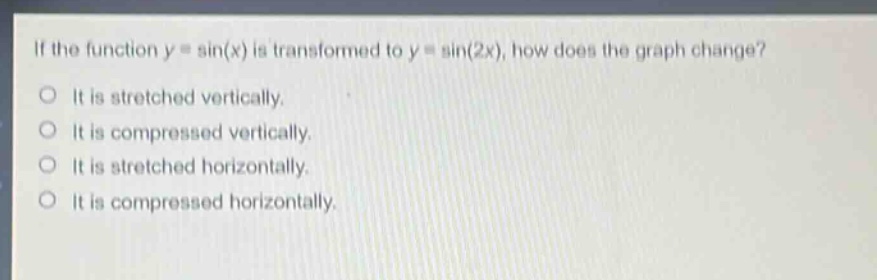
if the function y = sin(x) is transformed to y = sin(2x), how does the graph change?\no it is stretched vertically.\no it is compressed vertically.\no it is stretched horizontally.\no it is compressed horizontally.
Answer
Explanation:
Step1: Recall horizontal transformation rule
For $y = f(bx)$ where $b>0$, if $b > 1$, the graph of $y = f(x)$ is compressed horizontally by a factor of $\frac{1}{b}$.
Step2: Identify the value of $b$
In $y=\sin(2x)$ compared to $y = \sin(x)$, $b = 2$. Since $2>1$, the graph of $y=\sin(x)$ is compressed horizontally.
Answer:
It is compressed horizontally.