if the function $y = \\sin x$ is transformed to $y = 3\\sin(\\frac{2}{3}x)$, how do the amplitude and period…
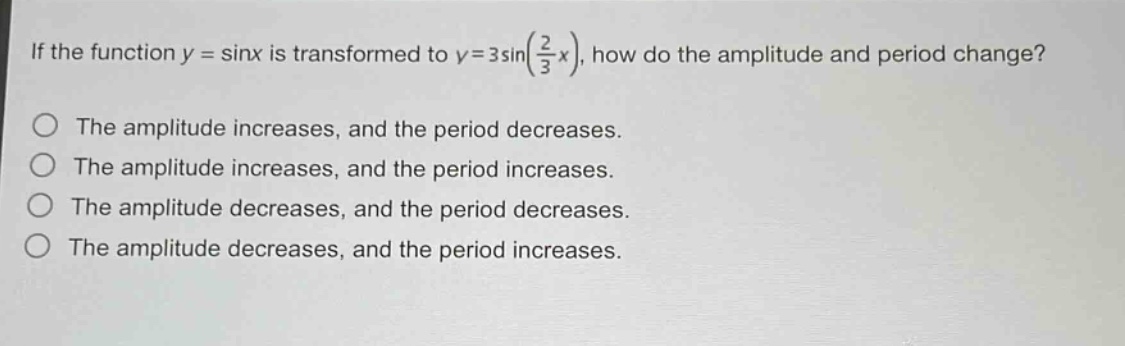
if the function $y = \\sin x$ is transformed to $y = 3\\sin(\\frac{2}{3}x)$, how do the amplitude and period change?\nthe amplitude increases, and the period decreases.\nthe amplitude increases, and the period increases.\nthe amplitude decreases, and the period decreases.\nthe amplitude decreases, and the period increases.
Answer
Explanation:
Step1: Recall amplitude formula
For $y = A\sin(Bx)$, amplitude is $|A|$. For $y=\sin x$, $A = 1$, amplitude is 1. For $y = 3\sin(\frac{2}{3}x)$, $A = 3$, and $3>1$, so amplitude increases.
Step2: Recall period formula
The period of $y=\sin x$ is $T_1 = 2\pi$. For $y = A\sin(Bx)$, period $T=\frac{2\pi}{|B|}$. For $y = 3\sin(\frac{2}{3}x)$, $B=\frac{2}{3}$, and $T_2=\frac{2\pi}{\frac{2}{3}}=3\pi$. Since $3\pi>2\pi$, period increases.
Answer:
The amplitude increases, and the period increases.