which function could be a stretch of the exponential decay function shown on the graph?\n$f(x)=2(6)^{x}$\n$f(…
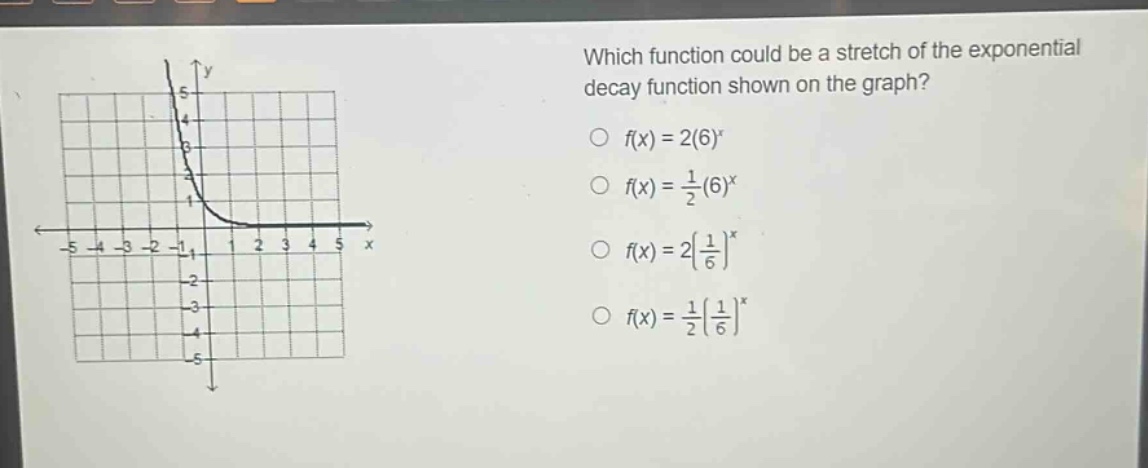
which function could be a stretch of the exponential decay function shown on the graph?\n$f(x)=2(6)^{x}$\n$f(x)=\\frac{1}{2}(6)^{x}$\n$f(x)=2(\\frac{1}{6})^{x}$\n$f(x)=\\frac{1}{2}(\\frac{1}{6})^{x}$
Answer
Explanation:
Step1: Recall the general form of an exponential function
The general form of an exponential function is (y = a\cdot b^{x}), where (a) is the vertical stretch or compression factor and (b) determines growth ((b> 1)) or decay ((0 < b<1)).
Step2: Analyze the growth/decay factor for each option
- For (f(x)=2(6)^{x}), since (b = 6>1), it is an exponential growth function.
- For (f(x)=\frac{1}{2}(6)^{x}), since (b = 6>1), it is an exponential growth function.
- For (f(x)=2(\frac{1}{6})^{x}), we can rewrite it as (f(x)=2\cdot6^{-x}). Here (a = 2) (vertical stretch) and (0<\frac{1}{6}<1) (exponential decay).
- For (f(x)=\frac{1}{2}(\frac{1}{6})^{x}), (a=\frac{1}{2}) (vertical compression).
Answer:
(f(x)=2(\frac{1}{6})^{x}) (the third option)