the function g(x) = tan(x + c) + d is a transformation of the parent function f(x) = tan x. if g(x) has an…
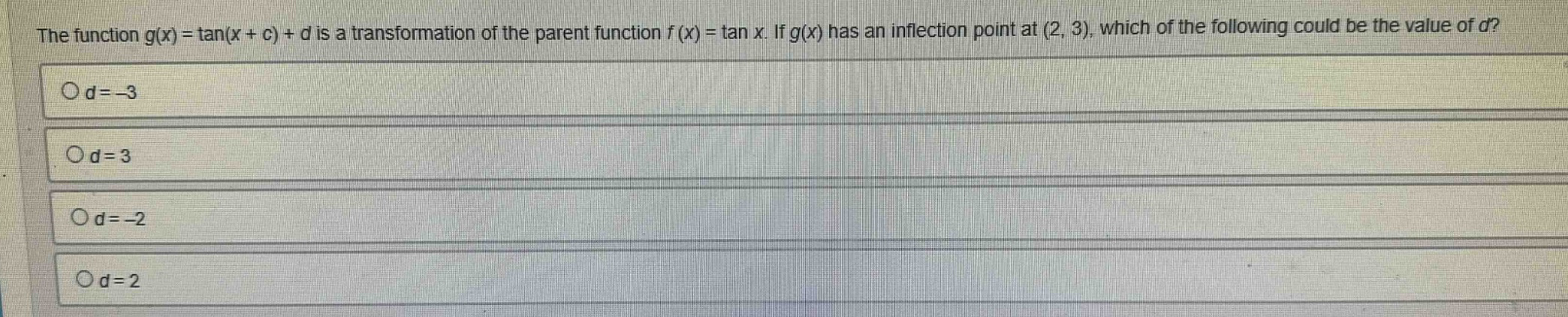
the function g(x) = tan(x + c) + d is a transformation of the parent function f(x) = tan x. if g(x) has an inflection point at (2, 3), which of the following could be the value of d?\no d = -3\no d = 3\no d = -2\no d = 2
Answer
Explanation:
Step1: Recall tangent - function properties
The parent function (y = \tan x) has an inflection - point at ((0,0)). The function (g(x)=\tan(x + c)+d) is a transformation of (y = \tan x). The general form of a horizontal shift is (y=\tan(x + c)) (left - shift by (c) units if (c>0) and right - shift by (|c|) units if (c < 0)) and a vertical shift is (y=\tan x + d) (upward shift by (d) units if (d>0) and downward shift by (|d|) units if (d < 0)).
Step2: Analyze the vertical shift
For the parent function (y = \tan x) with an inflection - point at ((0,0)) to be transformed to (g(x)=\tan(x + c)+d) with an inflection - point at ((2,3)), the vertical shift is determined by the (y) - coordinate of the inflection - point. The vertical shift of the function (y = \tan x) to (y=\tan(x + c)+d) moves the inflection - point from ((0,0)) to ((2,3)). The value of (d) represents the vertical shift. Since the (y) - coordinate of the inflection - point of the transformed function is (3), and the (y) - coordinate of the inflection - point of the parent function is (0), the vertical shift (d = 3).
Answer:
B. (d = 3)