for the function (f) whose graph is given, state the value of each quantity, if it exists. (if an answer…
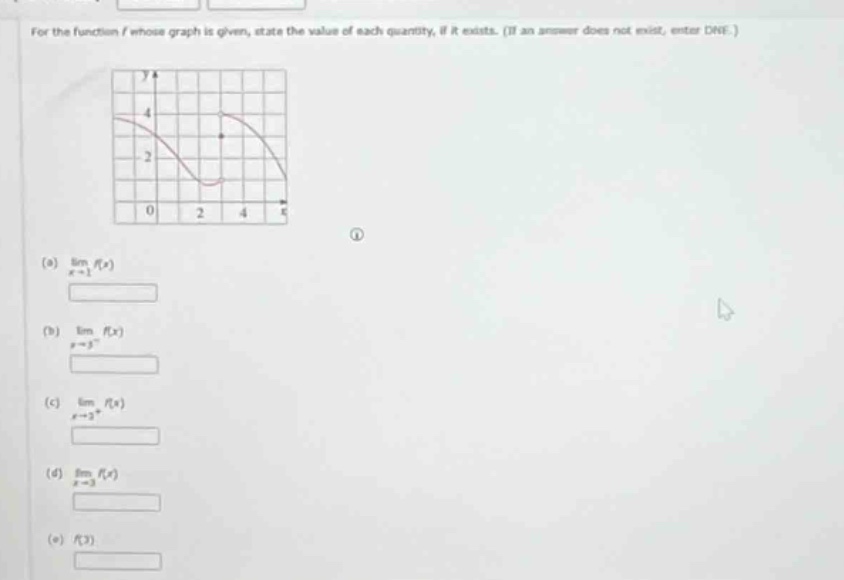
for the function (f) whose graph is given, state the value of each quantity, if it exists. (if an answer does not exist, enter dne.)\n(a) (lim_{x\rightarrow1}f(x))\n(b) (lim_{x\rightarrow3^{-}}f(x))\n(c) (lim_{x\rightarrow3^{+}}f(x))\n(d) (lim_{x\rightarrow3}f(x))\n(e) (f(3))
Answer
Explanation:
Step1: Analyze left - hand limit as x→1
As x approaches 1 from the left side (values of x less than 1), the y - values of the function approach 3.
Step2: Analyze right - hand limit as x→1
As x approaches 1 from the right side (values of x greater than 1), the y - values of the function approach 3. So, $\lim_{x\rightarrow1}f(x)=3$.
Step3: Analyze left - hand limit as x→3
As x approaches 3 from the left side (values of x less than 3), the y - values of the function approach 1. So, $\lim_{x\rightarrow3^{-}}f(x)=1$.
Step4: Analyze right - hand limit as x→3
As x approaches 3 from the right side (values of x greater than 3), the y - values of the function approach 4. So, $\lim_{x\rightarrow3^{+}}f(x)=4$.
Step5: Analyze limit as x→3
Since $\lim_{x\rightarrow3^{-}}f(x)\neq\lim_{x\rightarrow3^{+}}f(x)$, $\lim_{x\rightarrow3}f(x)$ does not exist (DNE).
Step6: Find f(3)
The value of the function at x = 3 is the y - value of the filled - in point at x = 3. Looking at the graph, f(3)=1.
Answer:
(a) 3 (b) 1 (c) 4 (d) DNE (e) 1