7. the function f(x)=xln(2x) has one critical point. rounded to three decimal points, the critical point…
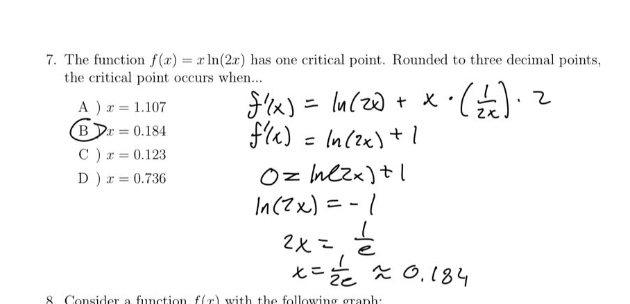
7. the function f(x)=xln(2x) has one critical point. rounded to three decimal points, the critical point occurs when... a ) x = 1.107 b ) x = 0.184 c ) x = 0.123 d ) x = 0.736 f(x)=ln(2x)+x·(1/2x)·2 f(x)=ln(2x)+1 0 = ln(2x)+1 ln(2x)= - 1 2x = 1/e x = 1/2e ≈ 0.184 8. consider a function f(x) with the following graph:
Answer
Explanation:
Step1: Find the derivative of the function
The derivative of $y = x\ln(2x)$ using the product - rule $(uv)^\prime=u^\prime v + uv^\prime$, where $u = x$ and $v=\ln(2x)$. The derivative of $u=x$ is $u^\prime = 1$, and the derivative of $v=\ln(2x)$ is $v^\prime=\frac{1}{2x}\cdot2=\frac{1}{x}$. So $f^\prime(x)=\ln(2x)+x\cdot\frac{1}{x}=\ln(2x) + 1$.
Step2: Set the derivative equal to zero
To find the critical points, we set $f^\prime(x)=0$. So $\ln(2x)+1 = 0$. Then we solve for $x$. First, we rewrite the equation as $\ln(2x)=- 1$.
Step3: Solve for $x$ using the property of logarithms
Since $\ln(2x)=-1$, and $y = \ln(u)$ is equivalent to $u = e^{y}$, we have $2x=e^{-1}=\frac{1}{e}$. Then $x=\frac{1}{2e}\approx0.184$.
Answer:
B. $x = 0.184$