function h(x)=xln(x)+k for x > 1. let j(x)={f(x) if -5≤x<0; g(x) if 0≤x≤1; h(x) if x > 1} (a) for each of…
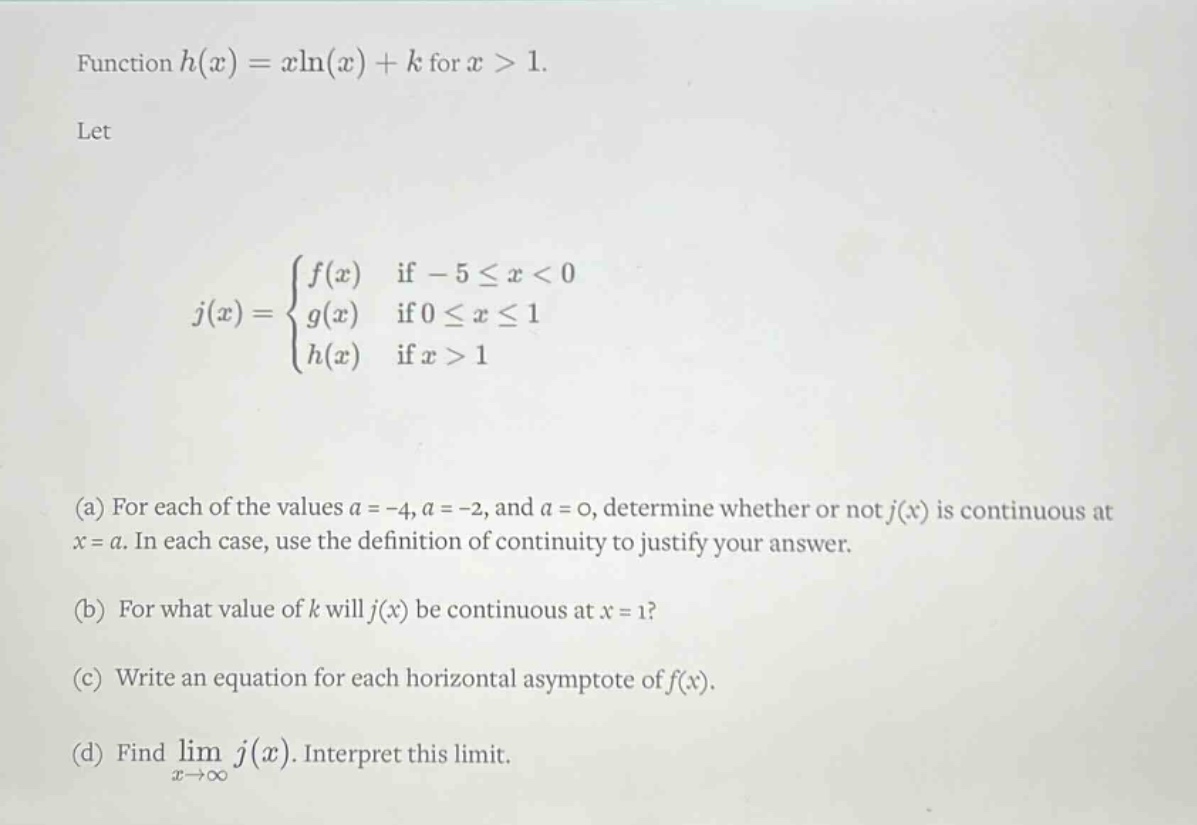
function h(x)=xln(x)+k for x > 1. let j(x)={f(x) if -5≤x<0; g(x) if 0≤x≤1; h(x) if x > 1} (a) for each of the values a = -4, a = -2, and a = 0, determine whether or not j(x) is continuous at x = a. in each case, use the definition of continuity to justify your answer. (b) for what value of k will j(x) be continuous at x = 1? (c) write an equation for each horizontal asymptote of f(x). (d) find lim x→∞ j(x). interpret this limit.
Answer
Explanation:
Step1: Recall continuity definition
A function $y = j(x)$ is continuous at $x=a$ if $\lim_{x\rightarrow a^{-}}j(x)=\lim_{x\rightarrow a^{+}}j(x)=j(a)$.
Step2: Analyze $a = - 4$
For $a=-4$, since $-5\leq - 4<0$, $j(x)=f(x)$ in an open - interval around $x = - 4$. The left - hand limit $\lim_{x\rightarrow - 4^{-}}j(x)=\lim_{x\rightarrow - 4^{-}}f(x)$ and the right - hand limit $\lim_{x\rightarrow - 4^{+}}j(x)=\lim_{x\rightarrow - 4^{+}}f(x)$. If $f(x)$ is continuous on $[-5,0)$, then $j(x)$ is continuous at $x=-4$. Without knowing more about $f(x)$, assume $f(x)$ is continuous on $[-5,0)$. So $\lim_{x\rightarrow - 4^{-}}j(x)=\lim_{x\rightarrow - 4^{+}}j(x)=j(-4)$ and $j(x)$ is continuous at $x = - 4$.
Step3: Analyze $a=-2$
For $a = - 2$, since $-5\leq - 2<0$, $j(x)=f(x)$ in an open - interval around $x=-2$. Similar to the case of $a=-4$, if $f(x)$ is continuous on $[-5,0)$, then $\lim_{x\rightarrow - 2^{-}}j(x)=\lim_{x\rightarrow - 2^{+}}j(x)=j(-2)$ and $j(x)$ is continuous at $x=-2$.
Step4: Analyze $a = 0$
The left - hand limit $\lim_{x\rightarrow0^{-}}j(x)=\lim_{x\rightarrow0^{-}}f(x)$ and the right - hand limit $\lim_{x\rightarrow0^{+}}j(x)=\lim_{x\rightarrow0^{+}}g(x)$. For $j(x)$ to be continuous at $x = 0$, we need $\lim_{x\rightarrow0^{-}}f(x)=\lim_{x\rightarrow0^{+}}g(x)=j(0)$. Without knowing more about $f(x)$ and $g(x)$, we cannot determine continuity.
Step5: Find $k$ for continuity at $x = 1$
For $j(x)$ to be continuous at $x = 1$, we need $\lim_{x\rightarrow1^{-}}j(x)=\lim_{x\rightarrow1^{+}}j(x)$. $\lim_{x\rightarrow1^{-}}j(x)=\lim_{x\rightarrow1^{-}}g(x)=g(1)$ and $\lim_{x\rightarrow1^{+}}j(x)=\lim_{x\rightarrow1^{+}}(x\ln(x)+k)=1\times\ln(1)+k=k$. So $k = g(1)$.
Step6: Find horizontal asymptote of $f(x)$
To find the horizontal asymptote of $f(x)$, we consider $\lim_{x\rightarrow\pm\infty}f(x)$. Since the domain of $f(x)$ is $-5\leq x<0$, we consider $\lim_{x\rightarrow - 5^{+}}f(x)$ and $\lim_{x\rightarrow0^{-}}f(x)$. If $\lim_{x\rightarrow - 5^{+}}f(x)=L_1$ and $\lim_{x\rightarrow0^{-}}f(x)=L_2$, the horizontal asymptotes (if they exist) are $y = L_1$ and $y = L_2$ (but we need more information about $f(x)$).
Step7: Find $\lim_{x\rightarrow\infty}j(x)$
Since for $x>1$, $j(x)=x\ln(x)+k$, and $\lim_{x\rightarrow\infty}x\ln(x)=\infty$ (using L'Hopital's rule: let $y = x\ln(x)=\frac{\ln(x)}{\frac{1}{x}}$, then $\lim_{x\rightarrow\infty}\frac{\ln(x)}{\frac{1}{x}}=\lim_{x\rightarrow\infty}\frac{\frac{1}{x}}{-\frac{1}{x^{2}}}=\lim_{x\rightarrow\infty}x=\infty$), so $\lim_{x\rightarrow\infty}j(x)=\infty$. This means that as $x$ gets larger and larger, the value of $j(x)$ increases without bound.
Answer:
(a) For $a=-4$ and $a = - 2$, if $f(x)$ is continuous on $[-5,0)$, $j(x)$ is continuous at $x=a$. For $a = 0$, continuity cannot be determined without more information about $f(x)$ and $g(x)$. (b) $k = g(1)$ (c) Need more information about $f(x)$ to determine horizontal asymptotes. (d) $\lim_{x\rightarrow\infty}j(x)=\infty$. As $x$ approaches infinity, $j(x)$ increases without bound.