do the functions have the same concavity?\n$f(x)=x^{2}-16x + 48$\nchoose 1 answer:\na yes, $f$ and $g$ are…
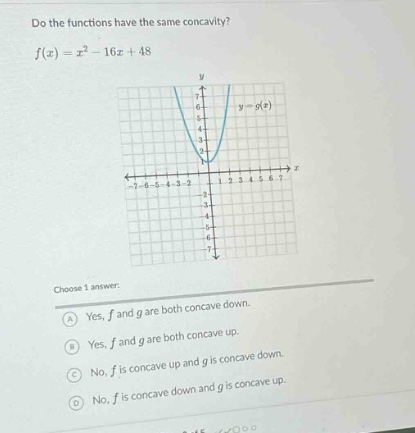
do the functions have the same concavity?\n$f(x)=x^{2}-16x + 48$\nchoose 1 answer:\na yes, $f$ and $g$ are both concave down.\nb yes, $f$ and $g$ are both concave up.\nc no, $f$ is concave up and $g$ is concave down.\nd no, $f$ is concave down and $g$ is concave up.
Answer
Explanation:
Step1: Find the second - derivative of $f(x)$.
First, find the first - derivative of $f(x)=x^{2}-16x + 48$. Using the power rule $(x^n)^\prime=nx^{n - 1}$, we have $f^\prime(x)=2x-16$. Then, find the second - derivative $f^{\prime\prime}(x)=(2x - 16)^\prime=2$.
Step2: Analyze the concavity of $f(x)$.
Since $f^{\prime\prime}(x)=2>0$, the function $f(x)$ is concave up.
Step3: Analyze the concavity of $g(x)$ from the graph.
The graph of $y = g(x)$ is a parabola opening upwards. For a parabola opening upwards, the second - derivative is positive, so $g(x)$ is concave up.
Answer:
B. Yes, $f$ and $g$ are both concave up.