the functions f and g are given by f(θ) = cos θ and g(θ) = sin θ. on which of the following intervals are…
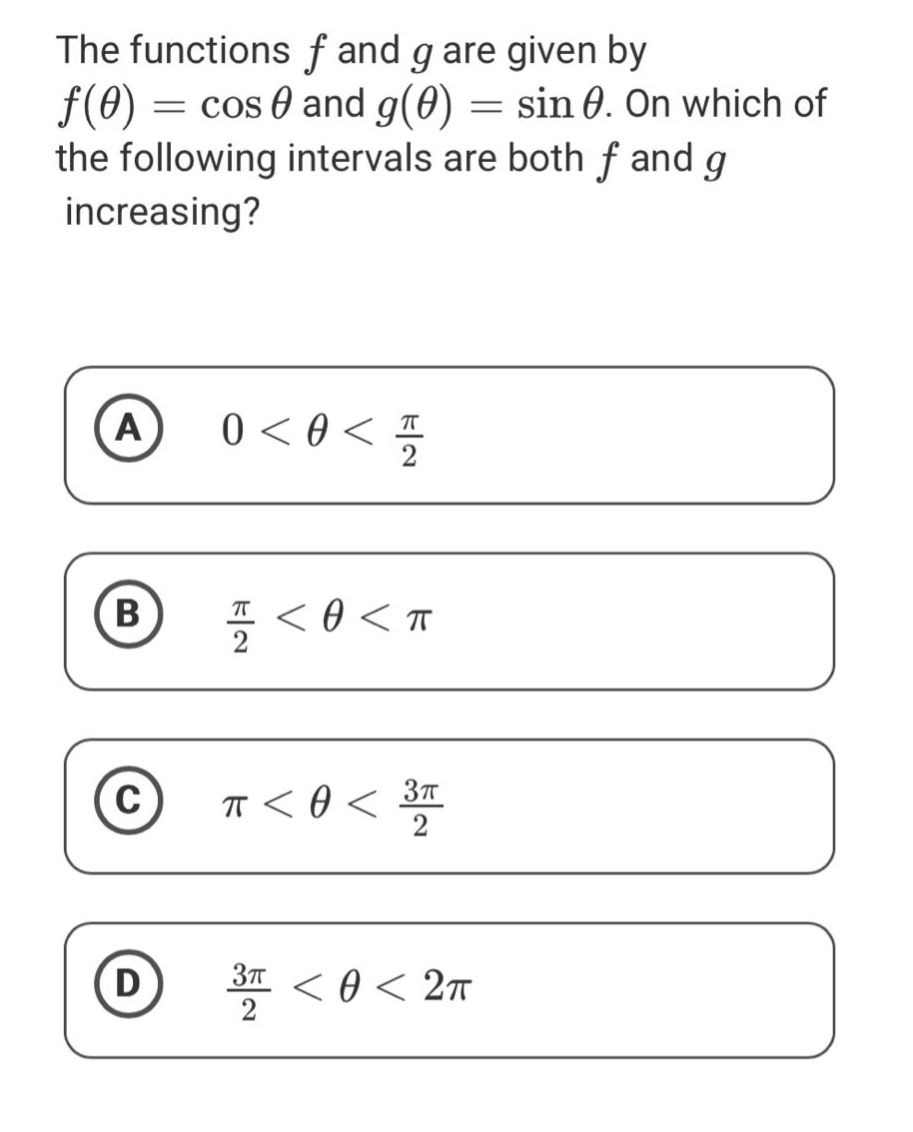
the functions f and g are given by f(θ) = cos θ and g(θ) = sin θ. on which of the following intervals are both f and g increasing? a 0 < θ < π/2 b π/2 < θ < π c π < θ < 3π/2 d 3π/2 < θ < 2π
Answer
Explanation:
Step1: Recall the derivative of trig - functions
The derivative of $f(\theta)=\cos\theta$ is $f'(\theta)=-\sin\theta$, and the derivative of $g(\theta)=\sin\theta$ is $g'(\theta)=\cos\theta$. A function is increasing when its derivative is positive.
Step2: Find when $f'(\theta)>0$
We want $-\sin\theta>0$, which is equivalent to $\sin\theta < 0$. The solutions of $\sin\theta<0$ are $\pi + 2k\pi<\theta<2\pi + 2k\pi,k\in\mathbb{Z}$.
Step3: Find when $g'(\theta)>0$
We want $\cos\theta>0$. The solutions of $\cos\theta > 0$ are $-\frac{\pi}{2}+2k\pi<\theta<\frac{\pi}{2}+2k\pi,k\in\mathbb{Z}$.
Step4: Find the common interval
Taking $k = 1$, the intersection of $\pi<\theta<2\pi$ and $\frac{3\pi}{2}<\theta<\frac{5\pi}{2}$ gives $\frac{3\pi}{2}<\theta<2\pi$.
Answer:
D. $\frac{3\pi}{2}<\theta<2\pi$