both of these functions grow as x gets larger and larger. which function eventually exceeds the…
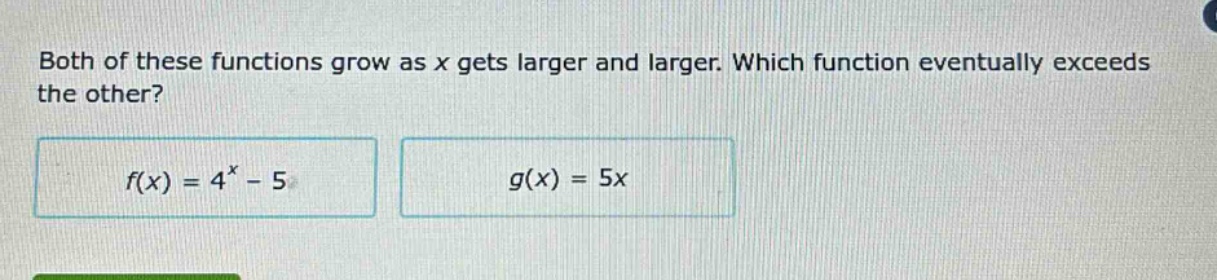
both of these functions grow as x gets larger and larger. which function eventually exceeds the other?\n$f(x)=4^{x}-5$\n$g(x)=5x$
Answer
Explanation:
Step1: Analyze growth - rate of exponential and linear functions
Exponential functions (y = a^x) ((a>1)) grow faster than linear functions (y = bx + c) ((b>0)) as (x\to+\infty). Here, (f(x)=4^x - 5) is an exponential - type function and (g(x)=5x) is a linear function.
Step2: Consider the long - term behavior
As (x) gets larger and larger, the exponential function (4^x) will dominate the linear function (5x). Even with the subtraction of 5 in (f(x)=4^x - 5), the growth rate of (4^x) will make (f(x)) eventually exceed (g(x)). We can also check by taking the limit (\lim_{x\to+\infty}\frac{4^x - 5}{5x}). Using L'Hopital's rule (since it is in the (\frac{\infty}{\infty}) form), the derivative of the numerator (y_1 = 4^x - 5) is (y_1^\prime=4^x\ln4), and the derivative of the denominator (y_2 = 5x) is (y_2^\prime = 5). Then (\lim_{x\to+\infty}\frac{4^x\ln4}{5}=+\infty).
Answer:
(f(x)=4^x - 5) eventually exceeds (g(x)=5x)