each of these functions grows as x gets larger and larger. which function eventually exceeds the others…
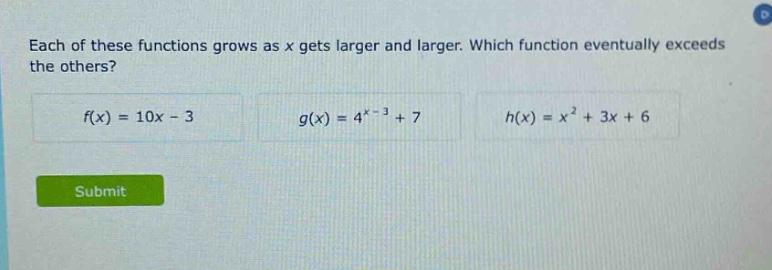
each of these functions grows as x gets larger and larger. which function eventually exceeds the others? f(x) = 10x - 3 g(x) = 4^(x - 3)+7 h(x) = x^2 + 3x + 6
Answer
Explanation:
Step1: Analyze function types
$f(x)=10x - 3$ is a linear - function of the form $y = mx + b$ where $m = 10$ and $b=-3$.
Step2: Analyze second function
$g(x)=4^{x - 3}+7$ is an exponential function of the form $y = a\cdot b^{x - h}+k$, here $a = 1$, $b = 4$, $h = 3$, $k = 7$.
Step3: Analyze third function
$h(x)=x^{2}+3x + 6$ is a quadratic function of the form $y=ax^{2}+bx + c$ with $a = 1$, $b = 3$, $c = 6$.
Step4: Recall growth - rate of functions
Exponential functions ($y = a\cdot b^{x}$, $b>1$) grow faster than polynomial functions (like linear $y=mx + b$ and quadratic $y = ax^{2}+bx + c$) as $x$ approaches infinity.
Answer:
$g(x)=4^{x - 3}+7$