each of these functions grows as x gets larger and larger. which function eventually exceeds the…
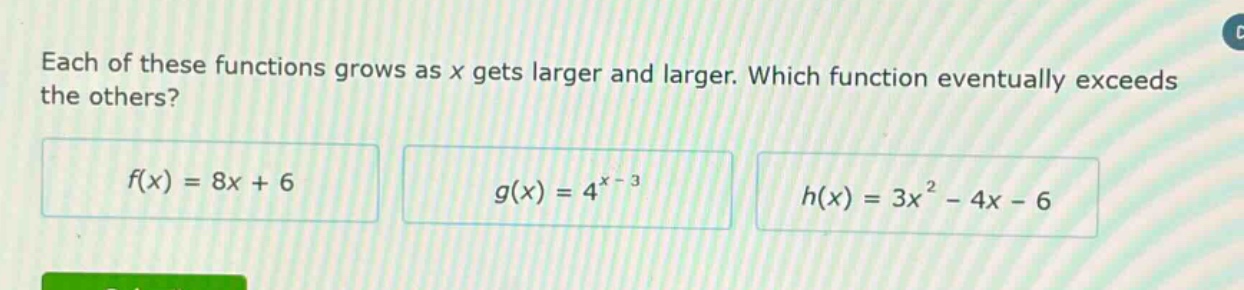
each of these functions grows as x gets larger and larger. which function eventually exceeds the others?\n$f(x)=8x + 6$\n$g(x)=4^{x - 3}$\n$h(x)=3x^{2}-4x - 6$
Answer
Answer:
$g(x)=4^{x - 3}$
Explanation:
Step1: Analyze the type of function $f(x)$
$f(x)=8x + 6$ is a linear function. As $x$ increases, its growth rate is constant. The slope of the line is 8, meaning it increases by 8 units for every 1 - unit increase in $x$.
Step2: Analyze the type of function $h(x)$
$h(x)=3x^{2}-4x - 6$ is a quadratic function. The general form of a quadratic function is $y = ax^{2}+bx + c$ ($a\neq0$). Here $a = 3>0$, so it is a parabola opening upwards. Its growth rate is proportional to $x$. As $x$ gets large, the $x^{2}$ - term dominates, and the function grows faster than a linear function.
Step3: Analyze the type of function $g(x)$
$g(x)=4^{x - 3}=\frac{4^{x}}{4^{3}}=\frac{4^{x}}{64}$ is an exponential function. For an exponential function $y = a^{x}$ ($a>1$), as $x$ increases, the function grows much faster than polynomial functions (linear and quadratic in this case). The growth rate of an exponential function is proportional to the function's current value. So, as $x$ gets very large, the exponential function $g(x)$ will eventually exceed both the linear function $f(x)$ and the quadratic function $h(x)$.