each of these functions grows as x gets larger and larger. which function eventually exceeds the…
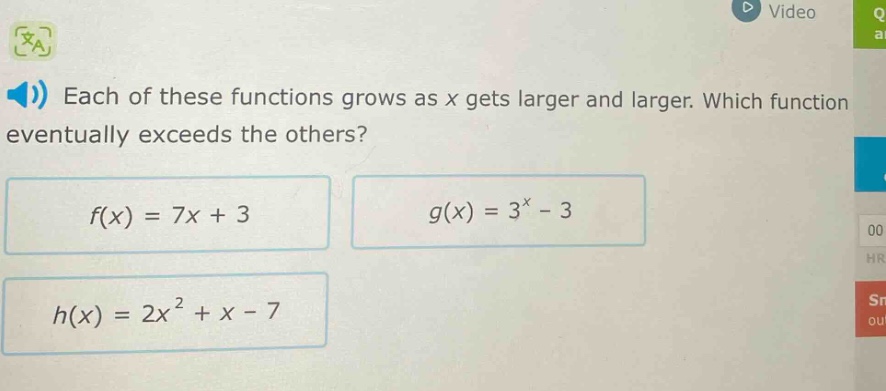
each of these functions grows as x gets larger and larger. which function eventually exceeds the others?\n$f(x)=7x + 3$\n$g(x)=3^{x}-3$\n$h(x)=2x^{2}+x - 7$
Answer
Explanation:
Step1: Analyze the growth rate of linear function
For the linear function (f(x)=7x + 3), the degree of (x) is (1). As (x) increases, its growth rate is relatively slow. The general form of a linear function is (y = mx + b) ((m>0)), and its growth is at a constant rate (slope (m)).
Step2: Analyze the growth rate of quadratic function
For the quadratic function (h(x)=2x^{2}+x - 7), the degree of (x) is (2). Using the power - rule for growth, as (x\to+\infty), (h(x)\approx2x^{2}). The growth rate of a polynomial function (y = a_nx^n+\cdots+a_1x + a_0) ((a_n>0,n>0)) is determined by the leading term (a_nx^n). Here (n = 2).
Step3: Analyze the growth rate of exponential function
For the exponential function (g(x)=3^{x}-3), as (x) increases, we use the property of exponential growth. The general form of an exponential function is (y = a\cdot b^{x}+c) ((a>0,b > 1)). As (x\to+\infty), (g(x)\approx3^{x}). We know the order of growth rates for functions as (x\to+\infty) is: linear function (y = mx + b) ((m>0)) (<) polynomial function (y=a_nx^n+\cdots+a_1x + a_0) ((a_n>0,n>1)) (<) exponential function (y=a\cdot b^{x}+c) ((a>0,b>1)).
Answer:
(g(x)=3^{x}-3)