functions over the interval 0≤x≤1?\nthe exponential grows at half the rate of the quadratic.\nthe…
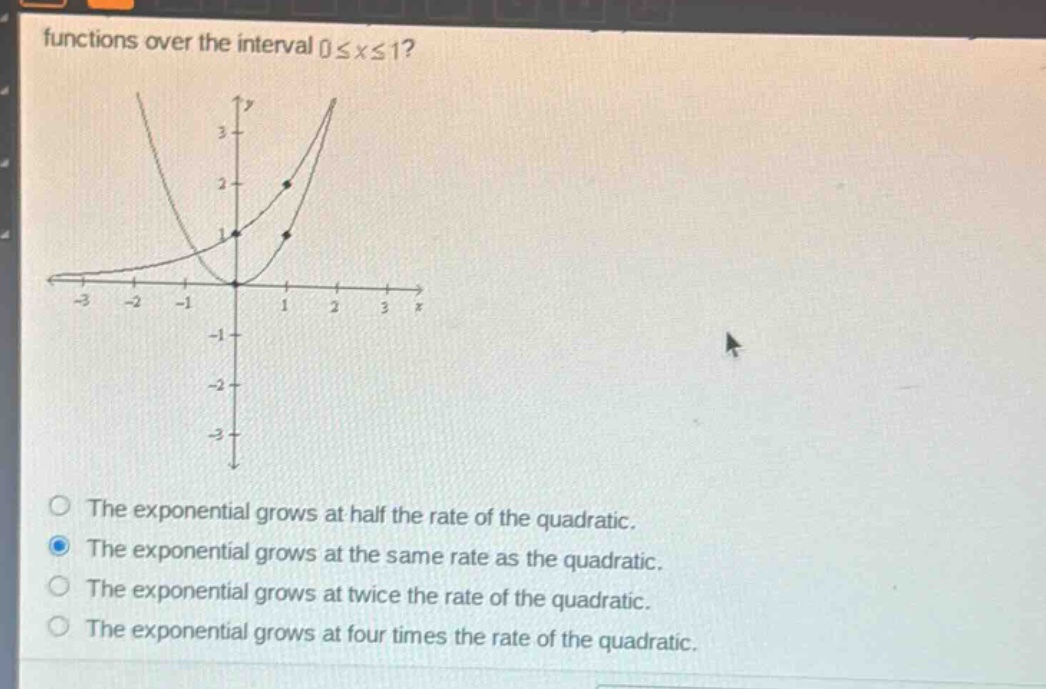
functions over the interval 0≤x≤1?\nthe exponential grows at half the rate of the quadratic.\nthe exponential grows at the same rate as the quadratic.\nthe exponential grows at twice the rate of the quadratic.\nthe exponential grows at four times the rate of the quadratic.
Answer
Explanation:
Step1: Recall rate - of - growth concept
The rate of growth of a function over an interval can be compared by looking at the change in the function values.
Step2: Analyze the given interval
For (0\leq x\leq1), assume the quadratic function is (y = ax^{2}) and the exponential function is (y = b\cdot c^{x}). Let's consider the general behavior of growth. We can also estimate the values of the two functions at (x = 0) and (x=1). At (x = 0), assume both functions have the same value (from the graph, they intersect at (x = 0)). Let (f(x)) be the quadratic function and (g(x)) be the exponential function. (f(0)=g(0)). At (x = 1), if we observe the graph, the increase in the value of the exponential function from (x = 0) to (x = 1) is the same as the increase in the value of the quadratic function from (x = 0) to (x = 1).
Answer:
The exponential grows at the same rate as the quadratic.