if f and g are the functions whose graphs are shown, let u(x) = f(x)g(x) and v(x) = f(x)/g(x). (a) find…
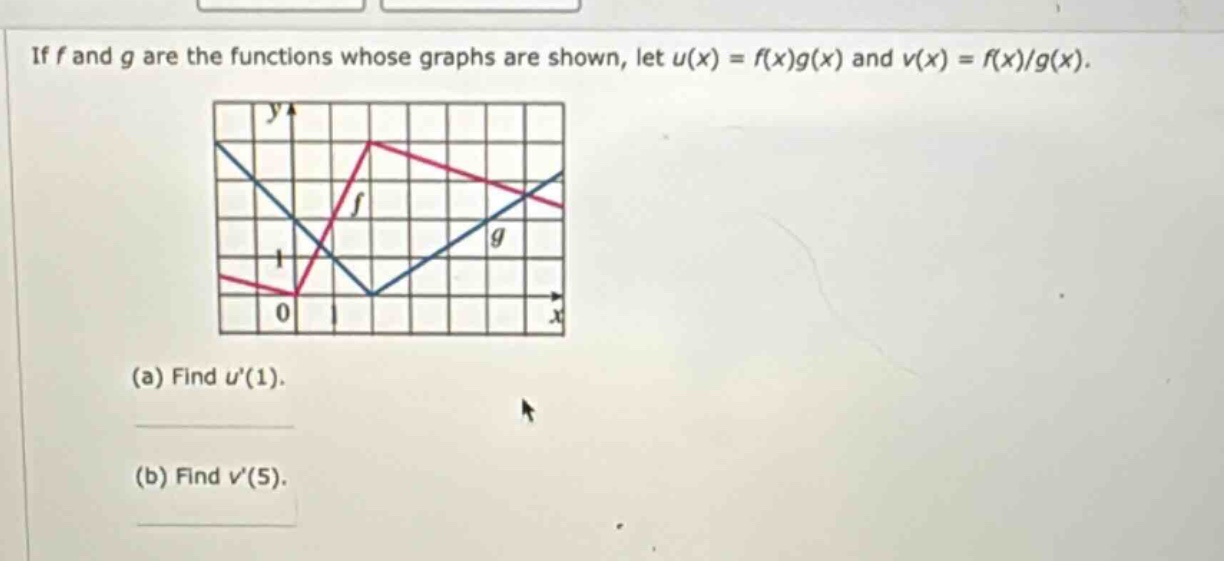
if f and g are the functions whose graphs are shown, let u(x) = f(x)g(x) and v(x) = f(x)/g(x). (a) find u(1). (b) find v(5).
Answer
Explanation:
Step1: Recall product - rule for $u(x)$
The product - rule states that if $u(x)=f(x)g(x)$, then $u^{\prime}(x)=f^{\prime}(x)g(x)+f(x)g^{\prime}(x)$. To find $u^{\prime}(1)$, we need to find $f(1)$, $f^{\prime}(1)$, $g(1)$ and $g^{\prime}(1)$ from the graphs. From the graph, $f(1) = 2$, $g(1)=1$. The slope of $y = f(x)$ at $x = 1$: For $x\in[0,2]$, $f(x)$ is a line with slope $m_f=\frac{4 - 0}{2-0}=2$, so $f^{\prime}(1)=2$. The slope of $y = g(x)$ at $x = 1$: For $x\in[0,2]$, $g(x)$ is a line with slope $m_g=\frac{0 - 2}{2 - 0}=-1$, so $g^{\prime}(1)=-1$.
Step2: Calculate $u^{\prime}(1)$
Substitute the values into the product - rule formula: $u^{\prime}(1)=f^{\prime}(1)g(1)+f(1)g^{\prime}(1)$. $u^{\prime}(1)=(2)\times(1)+(2)\times(-1)=2 - 2=0$.
Step3: Recall quotient - rule for $v(x)$
The quotient - rule states that if $v(x)=\frac{f(x)}{g(x)}$, then $v^{\prime}(x)=\frac{f^{\prime}(x)g(x)-f(x)g^{\prime}(x)}{g^{2}(x)}$. To find $v^{\prime}(5)$, we need to find $f(5)$, $f^{\prime}(5)$, $g(5)$ and $g^{\prime}(5)$ from the graphs. From the graph, $f(5)=1$, $g(5)=2$. For $x\in[4,6]$, the slope of $y = f(x)$ is $m_f=\frac{1 - 3}{6 - 4}=-1$, so $f^{\prime}(5)=-1$. For $x\in[4,6]$, the slope of $y = g(x)$ is $m_g=\frac{3 - 1}{6 - 4}=1$, so $g^{\prime}(5)=1$.
Step4: Calculate $v^{\prime}(5)$
Substitute the values into the quotient - rule formula: $v^{\prime}(5)=\frac{f^{\prime}(5)g(5)-f(5)g^{\prime}(5)}{g^{2}(5)}$. $v^{\prime}(5)=\frac{(-1)\times(2)-(1)\times(1)}{2^{2}}=\frac{-2 - 1}{4}=-\frac{3}{4}$.
Answer:
(a) $0$ (b) $-\frac{3}{4}$