what is the general equation of a cosine function with an amplitude of 3, a period of 4π, and a horizontal…
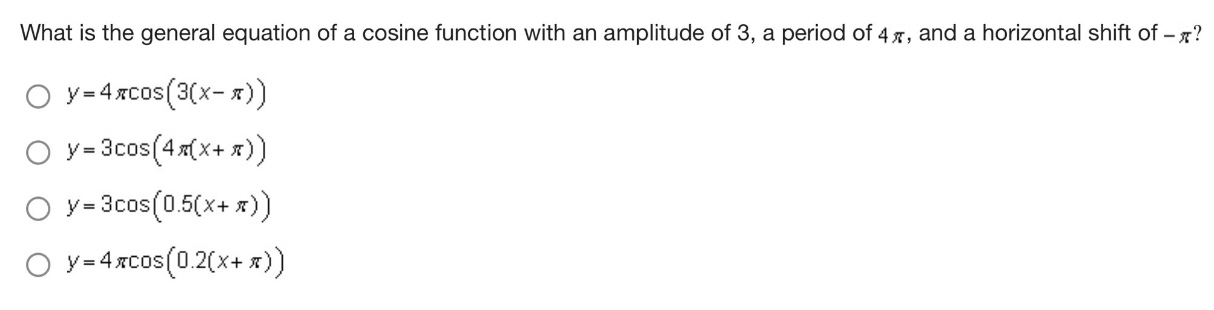
what is the general equation of a cosine function with an amplitude of 3, a period of 4π, and a horizontal shift of -π?\n$y = 4picos(3(x - pi))$\n$y = 3cos(4pi(x+pi))$\n$y = 3cos(0.5(x+pi))$\n$y = 4picos(0.2(x+pi))$
Answer
Explanation:
Step1: Recall cosine - function general form
The general form of a cosine function is $y = A\cos(B(x - C))+D$, where $A$ is the amplitude, $B$ is related to the period by $T=\frac{2\pi}{B}$, $C$ is the horizontal shift, and $D$ is the vertical shift (in this case $D = 0$).
Step2: Determine the amplitude $A$
Given that the amplitude $A = 3$.
Step3: Calculate the value of $B$
The period $T = 4\pi$. Since $T=\frac{2\pi}{B}$, we substitute $T = 4\pi$ into the formula: $4\pi=\frac{2\pi}{B}$. Solving for $B$ gives $B=\frac{2\pi}{4\pi}=0.5$.
Step4: Determine the horizontal - shift $C$
The horizontal shift is $C=-\pi$.
Step5: Write the cosine function
Substituting $A = 3$, $B = 0.5$, and $C=-\pi$ into $y = A\cos(B(x - C))$, we get $y = 3\cos(0.5(x-(-\pi)))=3\cos(0.5(x + \pi))$.
Answer:
$y = 3\cos(0.5(x+\pi))$ (the third option)