what is the general equation of a sine function with an amplitude of 6, a period of $\frac{pi}{4}$, and a…
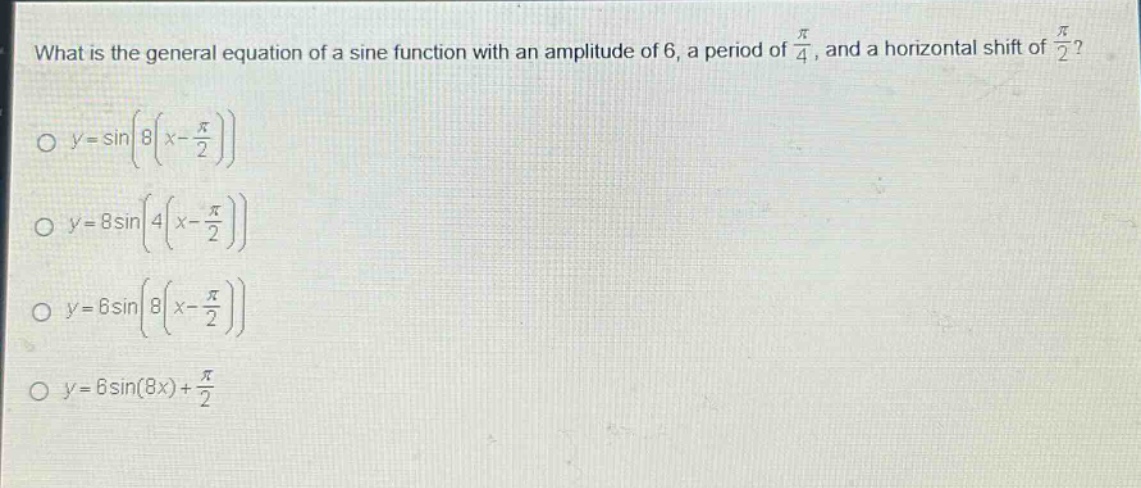
what is the general equation of a sine function with an amplitude of 6, a period of $\frac{pi}{4}$, and a horizontal shift of $\frac{pi}{2}$?\n$y = sinleft(8left(x-\frac{pi}{2}\right)\right)$\n$y = 8sinleft(4left(x-\frac{pi}{2}\right)\right)$\n$y = 6sinleft(8left(x-\frac{pi}{2}\right)\right)$\n$y = 6sin(8x)+\frac{pi}{2}$
Answer
Answer:
C. $y = 6\sin\left(8\left(x-\frac{\pi}{2}\right)\right)$
Explanation:
Step1: Recall sine - function general form
The general form of a sine function is $y = A\sin(B(x - h))+k$, where $A$ is the amplitude, $B$ is related to the period by $T=\frac{2\pi}{B}$, and $h$ is the horizontal shift.
Step2: Determine the amplitude $A$
Given amplitude $A = 6$.
Step3: Calculate the value of $B$
We know that the period $T=\frac{\pi}{4}$, and since $T=\frac{2\pi}{B}$, then $\frac{\pi}{4}=\frac{2\pi}{B}$. Cross - multiply gives $\pi B = 8\pi$, so $B = 8$.
Step4: Determine the horizontal shift $h$
Given horizontal shift $h=\frac{\pi}{2}$.
Step5: Write the function
Substituting $A = 6$, $B = 8$, and $h=\frac{\pi}{2}$ into $y = A\sin(B(x - h))$, we get $y = 6\sin\left(8\left(x-\frac{\pi}{2}\right)\right)$.